
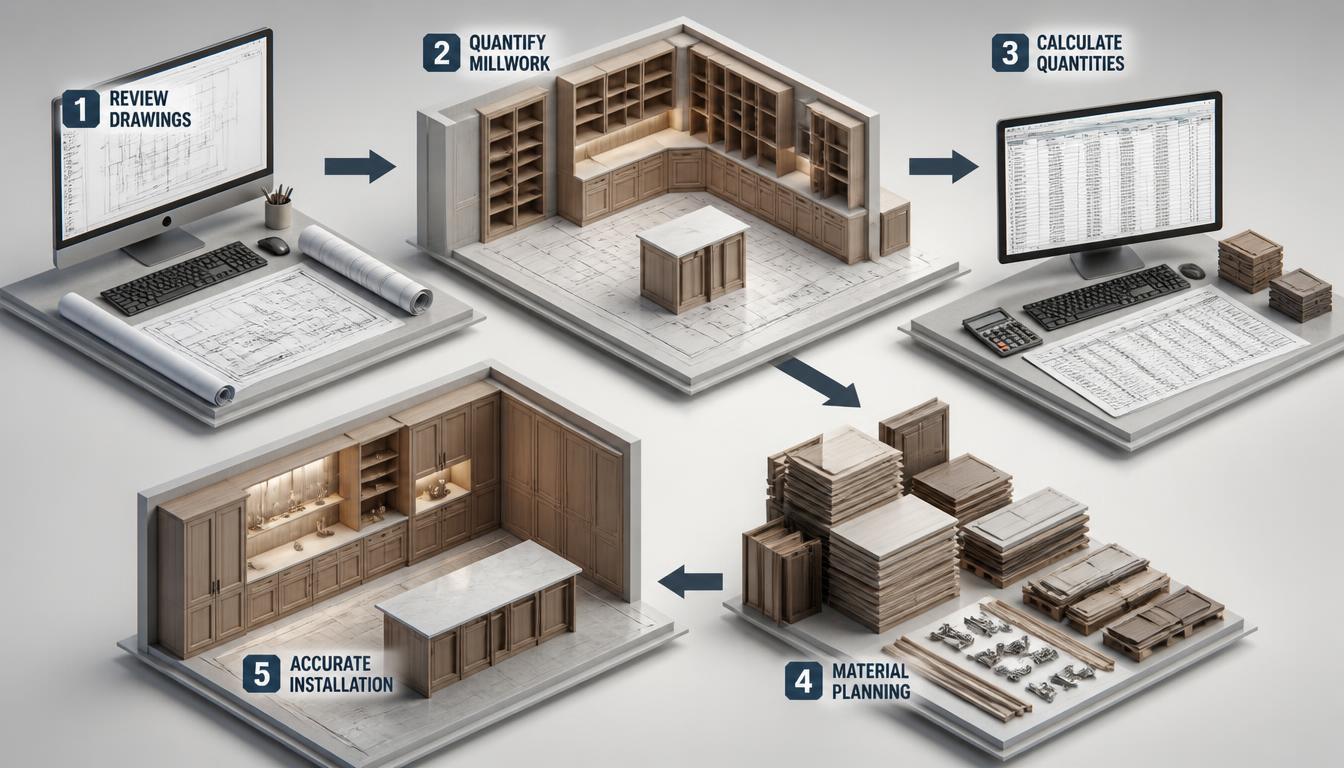
Millwork takeoff services help contractors develop detailed material quantities from architectural drawings. They turn design drawings into organized lists of measurable items.
This process sets clear targets for project costs, materials, and schedules.
Specialist firms like Universe Estimating organize drawings, schedules, elevations, and specifications into a practical material list for early cost review.
How Do Millwork Takeoff Services Build A Reliable Quantity Baseline?
Millwork takeoff services turn design information into measurable scope. An estimator reviews plans, interior elevations, schedules, details, and specifications to identify each millwork component.
A millwork quantity takeoff can separate items by type, size, material, finish, and location. That separation gives contractors a clearer record for pricing, supplier communication, and later scope checks.
The process also helps reveal missing information. These services can flag gaps before those gaps reach procurement or fabrication.
Which Details Should Be Measured Before Ordering?
Quantity alone is not enough. The estimate should connect each item with dimensions, material descriptions, finishes, and project locations.
A structured takeoff can record the main millwork elements in a format that supports quick review.
| Takeoff Item | Key Details To Record | Primary Use |
| Casework | Size, count, material | Purchasing |
| Panels and trim | Area, length, finish | Fabrication |
| Doors and hardware | Count, type, finish | Ordering |
| Countertops | Length, depth, material | Coordination |
These categories help contractors trace measured scope back to the documents. They also simplify revisions when dimensions, finishes, or room layouts change.
How Can Accurate Quantities Affect Purchasing Decisions?
Better quantities can make procurement more deliberate. Contractors can compare required amounts with supplier packages and identify unusual quantities before purchase orders are prepared.
Example
Consider a hypothetical hotel renovation. Suppose drawings show 42 guest-room vanities, but later revisions increase the count to 46.
A revised takeoff would identify the additional units before fabrication begins. That change could affect boards, laminate, hardware, labor allowances, delivery space, and installation planning.
This is where material quantities become useful for procurement decisions. These services connect them with purchasing decisions and help teams understand revisions.
What Cost Risks Can Early Quantity Review Expose?
Small omissions can create larger commercial problems. GAO reviewed 252 fixed-price construction subcontracts completed in fiscal year 2023. Their final costs exceeded initial estimates by over $37 million, or about 14%.
The finding does not specifically measure millwork takeoffs. However, it shows why documented scope, quantities, assumptions, and estimate updates matter when construction costs are controlled.
GAO recommends defining scope, documenting assumptions, collecting relevant data, analyzing risks, and updating estimates as conditions change.
For millwork, those practices can help teams track changes instead of treating each revision as an isolated pricing exercise.
Where Does The Takeoff Fit Into Preconstruction?
A quantity review from these services can support construction planning with a clearer view of material needs.
The record can also support bid comparisons. Different supplier units or descriptions can then be compared against one reference.
How Should Specialized Millwork Be Documented?
Detailed scope needs careful reading. Custom millwork may involve unique profiles, unusual dimensions, specialty veneers, integrated lighting, or project-specific hardware.
A takeoff should flag these conditions rather than treating every cabinet or panel as a standard item.
That distinction improves communication between estimators, fabricators, designers, and contractors.
A practical review should also separate confirmed quantities from allowances. This keeps uncertain scope visible and prevents assumptions from looking like finalized measurements.
What Should Contractors Have Before Fabrication Starts?
The final takeoff record should be easy to review and audit. It should show item descriptions, dimensions, quantities, locations, materials, finishes, and relevant drawing references.
A clear record answers simple questions quickly. Which room changed, which quantity moved, and which material needs a new price can all be traced more easily.
Conclusion
Precise millwork takeoff services help contractors set a clear scope before buying materials or starting installation. They link blueprints directly to exact quantities and specifications. This process leads to smarter purchasing decisions and tighter scope control. This can support more organized preconstruction coordination.

 English
 French
 Spanish
 Turkish
 Italiano
 Russian