
Preparing for the United States Medical Licensing Examination (USMLE) requires more than completing a large number of practice questions. The way students approach question banks can significantly influence their ability to build clinical reasoning skills, improve accuracy, and perform effectively under exam conditions.
Among the most commonly used resources for USMLE preparation, UWorld plays an important role in helping students understand question patterns, apply medical concepts, and identify knowledge gaps. However, many students struggle with an important decision: When should they move from Tutor Mode to Timed Mode?
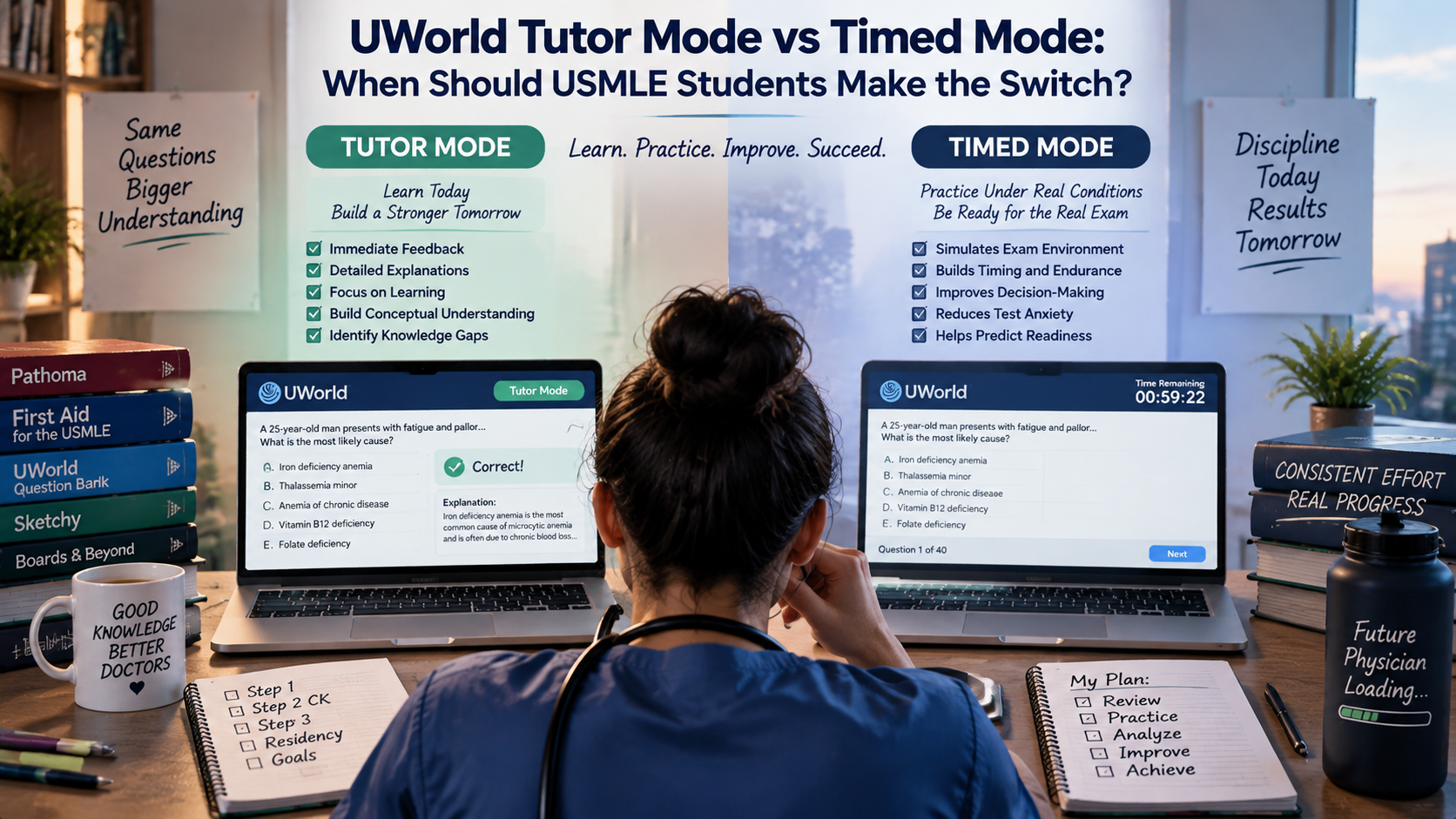
Both modes serve different purposes. Tutor Mode helps students learn concepts and analyze explanations, while Timed Mode develops exam endurance, pacing, and decision-making under pressure.
Understanding when and how to transition between these approaches can help medical students and international medical graduates (IMGs) create a more effective preparation strategy. Structured USMLE Tutoring can also help students analyze their performance, improve question-solving techniques, and develop a personalized plan based on their preparation stage.
Understanding UWorld Tutor Mode: Building Knowledge and Reasoning Skills
UWorld Tutor Mode allows students to answer questions while receiving immediate feedback after each question or block. This format is commonly used during the early and middle stages of USMLE preparation.
The primary purpose of Tutor Mode is learning.
Students can use this mode to:
-
Understand why answers are correct or incorrect
-
Review detailed explanations
-
Identify knowledge gaps
-
Learn clinical reasoning approaches
-
Connect concepts across different medical disciplines
For students beginning USMLE preparation, Tutor Mode provides an opportunity to slow down and focus on understanding rather than speed.
Benefits of UWorld Tutor Mode
1. Immediate Learning Feedback
When students review explanations immediately after answering, they can quickly identify misunderstandings and correct incorrect thought processes.
For example, a student preparing for Step 1 may recognize that they remember a disease name but lack understanding of the underlying pathology mechanism. Tutor Mode allows them to address that weakness immediately.
2. Better Concept Integration
USMLE questions often combine multiple concepts. Tutor Mode helps students understand connections between:
-
Pathophysiology
-
Pharmacology mechanisms
-
Microbiology
-
Anatomy
-
Clinical presentations
This deeper understanding is especially valuable during early preparation.
3. Building Question-Solving Skills
Many students initially struggle because USMLE questions are different from traditional medical school exams. Tutor Mode helps them learn how to approach clinical vignettes and identify important information.
Understanding UWorld Timed Mode: Preparing for Exam Conditions
Timed Mode is designed to simulate the pressure and structure of the actual USMLE examination.
In this mode, students answer questions without immediate access to explanations. Instead, they complete a block first and review their performance afterward.
Timed Mode focuses on:
-
Speed
-
Accuracy under pressure
-
Time management
-
Exam endurance
-
Decision-making confidence
Students need these skills because USMLE exams require completing large numbers of questions within strict time limits.
When Should Students Switch From Tutor Mode to Timed Mode?
There is no universal timeline because every student begins preparation with a different level of medical knowledge and exam experience.
However, several readiness signals can indicate when a transition may be appropriate.
1. When Students Understand Core Concepts
Students should not switch to Timed Mode too early if they are still learning basic medical concepts.
A student who struggles with foundational subjects such as:
-
Physiology
-
Pathology
-
Pharmacology
-
Microbiology
may benefit from spending more time in Tutor Mode.
The goal is not simply to complete questions quickly but to build a strong knowledge foundation first.
2. When Question Accuracy Becomes More Consistent
Improved accuracy is another signal that students may be ready to introduce more timed practice.
Students can consider switching when they notice:
-
Fewer repeated mistakes
-
Better understanding of explanations
-
Improved performance across different topics
-
More confidence approaching unfamiliar questions
The transition does not need to be immediate. Many students combine both approaches during their preparation.
3. When the Exam Date Is Approaching
As the exam gets closer, students need to become comfortable with realistic testing conditions.
Timed practice becomes increasingly important because it helps develop:
-
Faster decision-making
-
Better pacing
-
Reduced exam anxiety
-
Improved concentration during long blocks
Students preparing for Step 1 or Step 2 CK should gradually increase timed practice rather than waiting until the final weeks.
How UWorld Mode Strategy Differs for Step 1 and Step 2 CK
The ideal transition approach can vary depending on the exam.
USMLE Step 1 Preparation
Step 1 focuses heavily on foundational medical sciences. Early preparation often requires more Tutor Mode because students need to understand mechanisms and integrate basic concepts.
Students may gradually introduce Timed Mode after developing stronger foundations.
USMLE Step 2 CK Preparation
Step 2 CK requires more clinical decision-making and patient management skills. Students may benefit from introducing Timed Mode earlier because clinical reasoning speed is an important part of the exam.
Students working with a USMLE Step 2 CK Prep Tutor often focus on balancing knowledge review with realistic clinical question practice.
Common Mistakes When Switching to Timed Mode
Many students make mistakes during this transition.
Switching Too Early
Moving to Timed Mode before understanding concepts can create frustration because students focus on speed rather than learning.
Staying in Tutor Mode Too Long
Some students become comfortable with unlimited time and immediate explanations but struggle when facing real exam conditions.
Ignoring Question Review
Timed practice is only valuable when students carefully analyze mistakes afterward.
Focusing Only on Scores
A lower percentage in timed blocks does not always indicate failure. Students should evaluate why mistakes occurred.
How USMLE Tutors Help Students Optimize UWorld Strategy
Choosing the right balance between Tutor Mode and Timed Mode can be challenging, especially for students preparing independently. Experienced USMLE Tutors can help students evaluate their question bank performance, identify weaknesses, and adjust their preparation strategy.
A personalized approach may include:
-
Reviewing UWorld analytics
-
Identifying recurring mistakes
-
Improving clinical reasoning
-
Creating realistic study schedules
-
Developing exam-day strategies
Students preparing for different stages may benefit from USMLE Step 1 Tutoring, USMLE Step 2 CK Tutoring, or comprehensive USMLE Step 1 & Step 2 Tutoring depending on their goals.
Creating the Right UWorld Practice Plan
A balanced UWorld strategy may include:
Early Preparation:
-
Primarily use Tutor Mode
-
Focus on understanding explanations
-
Build foundational knowledge
Middle Preparation:
-
Combine Tutor and Timed Mode
-
Practice mixed question blocks
-
Identify weak areas
Final Preparation:
-
Increase Timed Mode practice
-
Simulate exam conditions
-
Focus on speed and confidence
Students should adjust their approach based on progress rather than following a fixed schedule.
Final Thoughts
UWorld Tutor Mode and Timed Mode both play important roles in USMLE preparation. Tutor Mode helps students build knowledge, understand explanations, and improve reasoning skills, while Timed Mode prepares them for the pressure and pacing of the actual examination.
The best approach is usually a gradual transition based on readiness, accuracy, and exam timeline. Students who need additional support can work with experienced USMLE Tutors to develop personalized strategies and improve their preparation process.
By using UWorld strategically and combining learning with realistic practice, medical students and IMGs can build the confidence and skills required for their USMLE journey.
FAQs
1. Should I start UWorld in Tutor Mode or Timed Mode?
Most students begin with Tutor Mode to understand concepts and question patterns before gradually introducing Timed Mode.
2. When should I switch from UWorld Tutor Mode to Timed Mode?
Students should consider switching when they understand core concepts, have improving accuracy, and need to develop exam pacing skills.
3. Is Timed Mode better than Tutor Mode for USMLE preparation?
Neither mode is better. They serve different purposes. Tutor Mode supports learning, while Timed Mode develops exam readiness.
4. Should Step 2 CK students use Timed Mode earlier?
Because Step 2 CK emphasizes clinical decision-making, many students introduce timed practice earlier to improve speed and reasoning.
5. Can Online USMLE Tutoring help improve UWorld performance?
Online USMLE Tutoring can provide personalized guidance, help analyze mistakes, and improve study strategies based on individual performance.

 English
 French
 Spanish
 Turkish
 Italiano
 Russian