
The Economics of Printing Are Changing Faster Than Print Technology
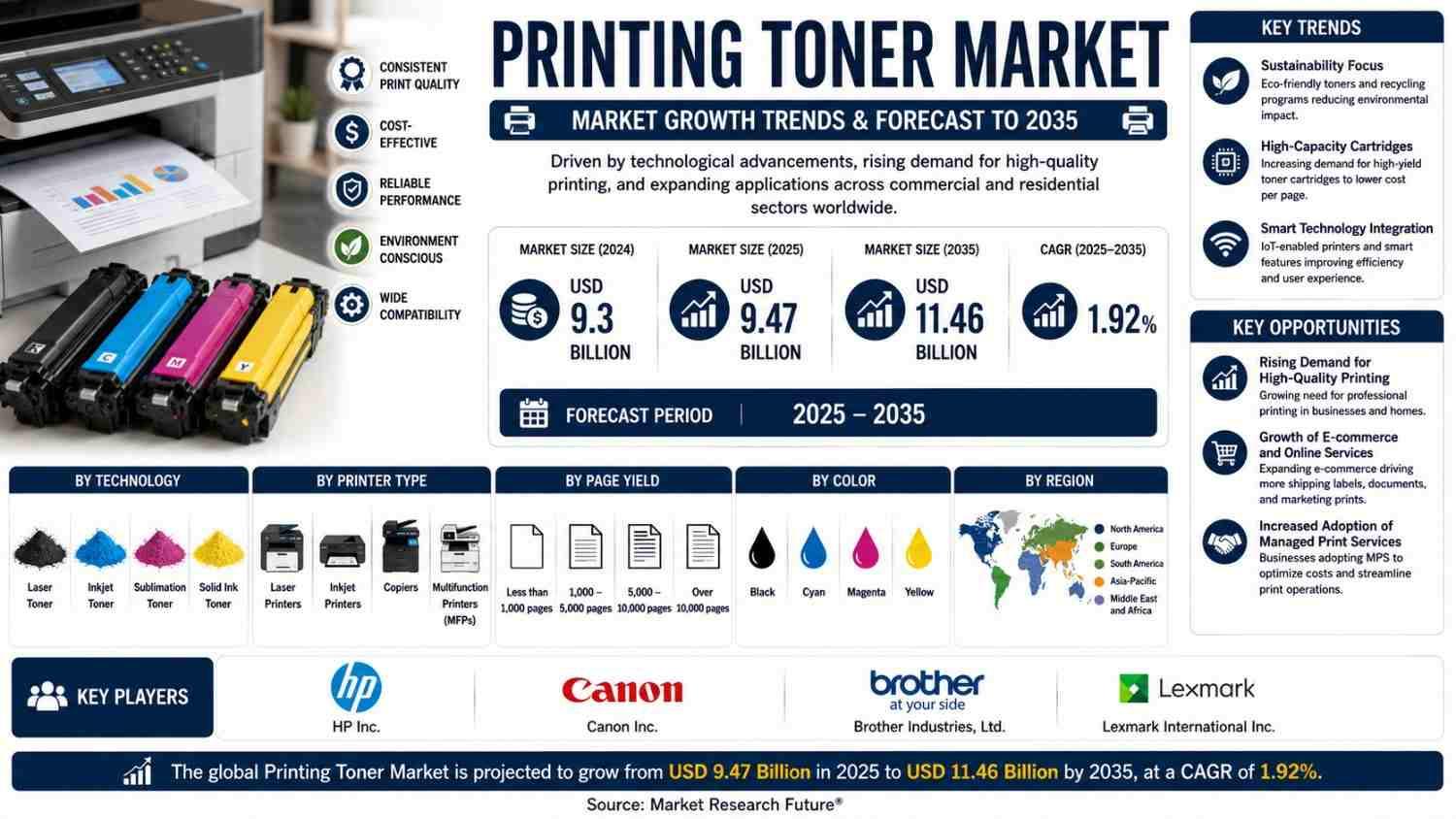
The printer may look familiar, but the business case behind it is changing. Companies are increasingly evaluating print equipment according to operating cost, cartridge yield, service efficiency, sustainability and connectivity rather than simply asking how quickly a machine can produce a page. That shift is supporting the Printing Toner Market Growth. The market stood at USD 9.3 billion in 2024 and increased to USD 9.47 billion in 2025. It is forecast to reach USD 11.46 billion by 2035, registering a CAGR of 1.92% during 2025–2035. The moderate pace indicates a mature market, but changing printer economics are creating new requirements for toner suppliers.
The critical commercial issue is simple: businesses want to spend less managing print while maintaining the quality and reliability of the documents they still need.
The Hidden Cost Behind a Toner Cartridge
The purchase price of a cartridge is only one part of its cost.
A low-yield cartridge can require frequent replacement. That means more inventory movements, more employee intervention and more opportunities for a printer to run out of consumables at an inconvenient time.
This is why high-capacity cartridges have become an important market trend. They can support more pages before replacement and potentially reduce the operational burden associated with printer maintenance.
For large enterprises, the calculation becomes even more significant. A company operating a substantial printer fleet can use managed print services to monitor usage and automate parts of the replenishment process.
Toner therefore sits within a wider service economy. Its value depends not only on the powder inside the cartridge but also on how efficiently the complete printing system operates.
Digitalization Is Not Removing Every Printing Requirement
The decline of routine office printing is real, but it does not apply equally across all applications.
Digital invoices may replace some paper invoices, yet warehouses still require physical documents for selected logistics processes. Digital collaboration may reduce printed meeting materials, while manufacturing facilities continue to use physical technical instructions and production documentation.
E-commerce provides another example. The purchasing process is digital, but order fulfillment is physical. Shipping operations can still require printed documentation, labels and inventory-related materials.
This creates an important distinction between discretionary printing and operational printing.
Discretionary pages are easier to replace with digital alternatives. Operational pages are harder to eliminate because they perform a physical function within a workflow.
Why Laser Printing Remains Relevant
Laser toner continues to have an important role where speed, consistency and predictable output are required.
Business users often value printers that can handle repetitive workloads without frequent interruptions. Toner-based systems can be well suited to these environments, particularly where documents need consistent text and graphics.
Color printing expands the opportunity. Cyan, magenta, yellow and black toner must work together to produce accurate results, making formulation and printer engineering increasingly important.
Copiers and multifunction printers also support this demand. These machines combine several workplace functions and can serve as centralized printing hubs.
As offices become more digitally managed, these devices are increasingly expected to integrate with network systems and provide information about usage and maintenance.
Sustainability Creates a More Complicated Product Equation
The printing industry faces pressure to reduce waste, but the solution is not necessarily to eliminate toner consumption altogether.
If a cartridge produces substantially more pages before replacement, fewer cartridges may be needed for a fixed print workload. Yet manufacturers must also consider the material requirements of larger cartridges.
Recycling provides another opportunity. Cartridge recovery can keep materials in circulation and reduce waste, but collection networks must be efficient enough to make recovery practical.
Packaging is also under scrutiny. Reducing unnecessary material can improve the environmental profile of a product without affecting print performance.
The broader lesson is that sustainable printing requires lifecycle thinking rather than a single "eco-friendly" label.
Technology Is Moving Toward Predictive Print Management
Connected printers are changing the way businesses interact with toner.
Instead of discovering that a cartridge is empty when a critical document needs to be printed, organizations can use device information to monitor consumption and anticipate replacement requirements.
This capability is particularly valuable for managed print providers. They can use printer data to coordinate service, consumable delivery and fleet optimization.
Smart technology can also help businesses identify underused or inefficient devices. In some cases, the best cost-saving measure may not be buying a different cartridge but changing where printers are located or how they are used.
That makes toner demand increasingly connected to analytics and workflow management.
Competition Is Being Built Around the Complete Printing Platform
The leading companies named in the market include HP Inc., Canon Inc., Brother Industries Ltd., and Lexmark International Inc.
Their competitive positions extend beyond toner supply.
HP Inc. and Canon Inc. benefit from broad printer and imaging ecosystems. Brother Industries Ltd. has a strong connection with office and business printing, while Lexmark International Inc. has relevance in enterprise and managed printing environments.
This creates a structural advantage for integrated suppliers. When hardware, toner and software work together, customers may evaluate the complete operating system rather than switching based only on cartridge price.
Regional Markets Reflect Different Business Priorities
North America has a mature installed base and strong enterprise printing requirements. Efficiency, fleet management and service integration are therefore important areas of competition.
Europe combines established printing demand with stronger sustainability considerations. Businesses and institutions are increasingly interested in reducing waste and improving resource efficiency.
Asia-Pacific has a more varied demand profile. Industrial production, business services, education and commercial activity provide multiple sources of printing demand. Differences in income, infrastructure and technology adoption mean that product requirements vary considerably across countries.
Emerging markets across other regions can benefit from business modernization and e-commerce expansion, but distribution and service infrastructure remain important to adoption.
The Most Promising Commercial Opportunities
Managed print services are one of the clearest opportunities because they convert printer consumables into a recurring operational service.
High-capacity cartridges can address businesses that prioritize lower replacement frequency. Smart cartridge technologies can support automated inventory management. Premium color toner can serve users requiring professional-quality output.
There is also room for innovation in sustainable cartridge materials and recovery systems.
The common denominator is measurable value. Customers are more likely to pay for a product or service when it reduces downtime, lowers cost per page, simplifies management or improves print quality.
What Could Hold the Market Back
The largest challenge remains the continuing shift toward digital workflows.
Cloud storage, electronic signatures, digital communications and paperless administration can all reduce print volumes. Printer replacement cycles may also become longer when businesses choose to maximize existing equipment.
Price competition creates another challenge. In a mature market growing at a measured pace, suppliers cannot depend solely on volume expansion.
They need differentiation through quality, yield, sustainability, connectivity and service.
What the Market Could Look Like by 2035
By 2035, toner is likely to remain an essential consumable in applications where physical documents retain operational value. However, the market will probably be less about mass office printing and more about efficient, targeted printing.
The expected expansion to USD 11.46 billion suggests that digitalization will reshape the market rather than erase it.
The strongest suppliers will be those that understand the changing economics of printing. A toner cartridge will increasingly be judged not by its standalone price, but by how effectively it contributes to a reliable, connected and resource-efficient printing system.
Another Trending Topics
High Purity Gaseous Helium Market | High Silica Fiber Market | High Strength Laminated Adhesive Market

 English
 French
 Spanish
 Turkish
 Italiano
 Russian