
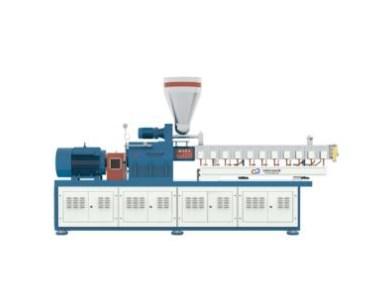
In the realm of materials science and polymer processing, the lab extruder machine stands as a beacon of innovation and versatility. Central to its operation is the precise control of extrusion speed and pressure, two parameters that dictate the quality, consistency, and efficiency of the extrusion process. In this article, we delve into the intricacies of controlling extrusion speed and pressure in a lab extruder machine to achieve optimal results.
Before delving into the specifics of speed and pressure control, it's essential to grasp the fundamental principles of extrusion. A lab extruder machine typically consists of a barrel, screw, and die assembly, where raw materials are fed, melted, and forced through a shaped orifice to form the desired product.
Extrusion speed, often referred to as screw speed or throughput rate, governs the rate at which material is transported and processed within the extruder. Lab extruder machines employ various mechanisms to control speed, including motorized screws, gearboxes, and software-controlled algorithms. By adjusting rotational speed, operators can modulate the flow rate and residence time of materials in the extruder, influencing factors such as melt temperature, viscosity, and mixing efficiency.
Pressure is another critical parameter in extrusion processes, exerting force to propel molten material through the die opening. In a lab extruder machine, pressure control is achieved through precise adjustment of screw design, barrel temperature, screw configuration, and die geometry. By optimizing these parameters, operators can maintain consistent pressure profiles along the extrusion pathway, minimizing fluctuations and ensuring uniform product quality.
Temperature plays a significant role in regulating both extrusion speed and pressure. By controlling barrel and die temperatures, operators can manipulate material viscosity, melt flow behavior, and heat transfer rates. Heat zones along the barrel allow for precise temperature profiling, ensuring optimal conditions for melting, mixing, and shaping materials. Additionally, temperature feedback loops and sensors provide real-time monitoring and adjustment, enhancing process stability and repeatability.
The design and geometry of the die play a crucial role in controlling extrusion speed and pressure. By carefully engineering the shape, dimensions, and land length of the die opening, operators can tailor flow characteristics and pressure distribution to match desired product specifications. Advanced die technologies, such as adjustable lips, flow restrictors, and multi-layer configurations, offer further flexibility in optimizing extrusion performance.
The rheological properties of the material being extruded significantly influence speed and pressure control. Materials with high viscosity or shear-thinning behavior may require higher processing temperatures and pressures to achieve proper flow. Rheological testing and characterization provide valuable insights into material behavior under extrusion conditions, guiding process optimization and parameter selection.
Screw Design and Configuration: The design and configuration of the extruder screw play a pivotal role in governing material transport, melting, and mixing. Different screw geometries, such as single-screw, twin-screw, or specialized designs, offer unique advantages in terms of conveying efficiency, shear rates, and distributive mixing. By selecting the appropriate screw design and flight configuration, operators can optimize extrusion performance and control speed and pressure with precision.
In conclusion, mastering extrusion speed and pressure control in a lab extruder machine is essential for achieving consistent, high-quality results in materials processing and research. By understanding the underlying principles, employing advanced technologies, and leveraging operator expertise, researchers can harness the full potential of their lab extrusion capabilities to drive innovation and discovery in the field of materials science.

 English
 French
 Spanish
 Deutsch
 Turkish
 Russian