
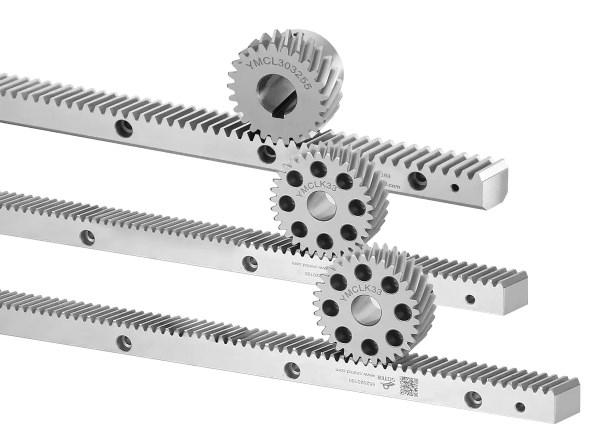
Rack and pinion gear is an essential component in many mechanical systems, translating rotational motion into linear motion and vice versa with precision and efficiency. The choice of materials for rack and pinion gears is crucial, as it significantly impacts their performance, durability, and reliability. In this article, we explore the various material options available for rack and pinion gears and their influence on gear performance.
Steel is one of the most common materials used for rack and pinion gears due to its excellent strength, durability, and wear resistance. It is capable of withstanding heavy loads and high-speed applications, making it suitable for industrial machinery, automotive steering systems, and robotics. Steel rack and pinion gears exhibit minimal wear and deformation over time, ensuring long-term performance and reliability in demanding operating conditions.
Cast iron is another popular choice for rack and pinion gears, prized for its high strength, vibration-damping properties, and cost-effectiveness. Cast iron gears offer good wear resistance and dimensional stability, making them suitable for applications where noise, vibration, and shock absorption are critical factors. They are commonly used in heavy-duty machinery, construction equipment, and agricultural machinery.
Brass is often selected for rack and pinion gears in applications where corrosion resistance, lubricity, and aesthetic appeal are important considerations. Brass gears provide smooth and quiet operation, making them ideal for precision instruments, audio equipment, and camera mechanisms. They offer good wear resistance and self-lubricating properties, reducing the need for external lubrication and maintenance.
Bronze is valued for its high strength, corrosion resistance, and compatibility with various lubricants, making it suitable for rack and pinion gears in marine, aerospace, and chemical processing applications. Bronze gears exhibit excellent wear resistance and low friction characteristics, ensuring reliable performance in harsh and corrosive environments. They are often used in gearboxes, valve actuators, and conveyor systems.
Aluminum is chosen for rack and pinion gears in lightweight applications where weight reduction, thermal conductivity, and cost-effectiveness are priorities. Aluminum gears offer good strength-to-weight ratio and thermal stability, making them suitable for automotive, aerospace, and recreational equipment. However, they may exhibit lower wear resistance compared to steel or brass gears and are typically used in low-load, high-speed applications.
Plastic materials such as nylon, acetal, and polyethylene are increasingly used for rack and pinion gears in applications requiring low friction, corrosion resistance, and noise reduction. Plastic gears offer self-lubricating properties, chemical resistance, and the ability to operate without external lubrication. They are commonly found in consumer electronics, medical devices, and food processing equipment.
The choice of material for rack and pinion gears depends on various factors such as load capacity, operating conditions, environmental exposure, and cost considerations. Engineers and designers must carefully evaluate these factors to select the most suitable material that meets the performance requirements of the application. By selecting the right material for rack and pinion gears, manufacturers can optimize gear performance, longevity, and reliability, ensuring smooth and efficient operation in diverse mechanical systems.

 English
 Spanish
 Deutsch
 Turkish
 Italiano
 Russian