
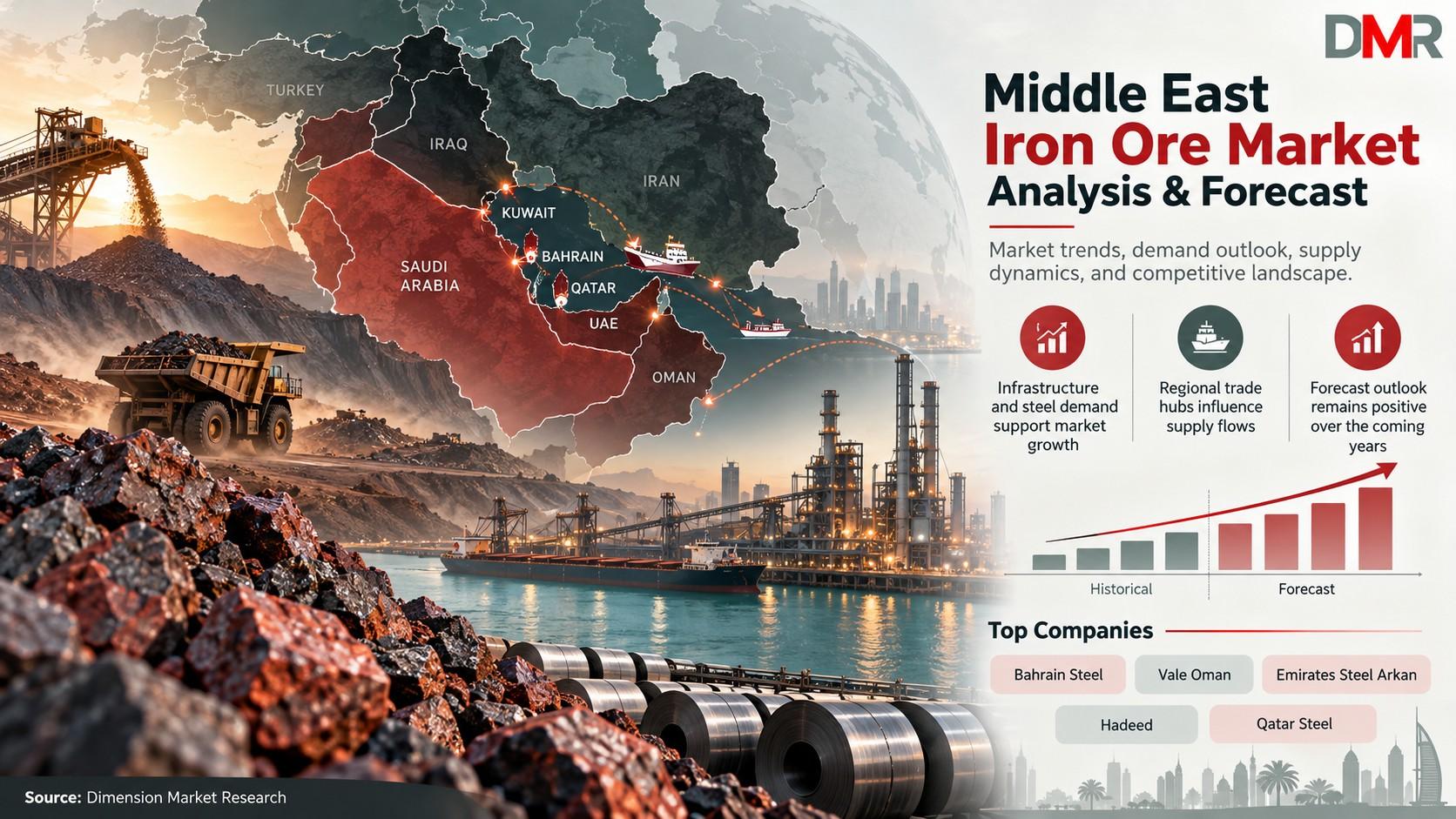
Middle East Iron Ore Market Overview: Growth Outlook Through 2035
The Middle East Iron Ore Market size is projected to reach USD 13.62 billion by 2035, rising from USD 9.47 billion in 2026 at a compound annual growth rate (CAGR) of 4.12%, according to Dimension Market Research. Growing steel manufacturing capacity, expanding direct reduced iron (DRI) production, and investment in advanced steelmaking technologies are shaping the industry's growth trajectory.
The regional market serves an interconnected industrial ecosystem spanning iron ore mining, beneficiation, pellet production, steel manufacturing, and international trade. Iran benefits from established domestic mining and processing infrastructure, while Gulf economies increasingly depend on imported iron-bearing materials to support their steelmaking industries. This difference creates opportunities for domestic producers, international suppliers, traders, and processing companies.
As steelmakers pursue higher productivity and lower-emission production methods, demand for consistent iron content and suitable metallurgical properties is becoming increasingly important. Investments in premium concentrates, direct reduction-grade pellets, and regional processing facilities are expected to influence procurement strategies and competitive positioning through 2035.
Middle East Iron Ore Market Snapshot
● Market value: USD 9.47 billion in 2026.
● Forecast value: USD 13.62 billion by 2035.
● Market CAGR: 4.12% during 2026 to 2035.
● Leading product: Iron ore fines, with a 44.3% share in 2026.
● Leading grade: Medium-grade iron ore, with a 42.5% share.
● Leading end-user: Steel manufacturing, with a 52.4% share.
● Leading country: Iran, accounting for 22.0% of revenue in 2026.
● Historical data: 2021 to 2025.
● Forecast period: 2027 to 2035.
Get insight you need (request free sample)
Middle East Iron Ore Market Research Findings
The research identifies a market shaped by contrasting production and consumption patterns across the region. Iran's established mining industry supports domestic iron ore extraction, concentration, pelletizing, and steel production. Meanwhile, Oman and Bahrain play important roles in processing and pellet distribution, while Saudi Arabia and the UAE offer opportunities linked to steel capacity expansion and imported feedstock requirements.
Iron ore fines held the leading product position in 2026, while medium-grade material remained the largest grade category. Steel manufacturing accounted for the largest end-user share. These findings highlight the importance of both conventional steel production and evolving direct reduction technologies. Through 2035, ore quality, processing efficiency, logistics reliability, and access to suitable feedstock are expected to influence investment decisions and supplier competitiveness.
Why Is the Middle East Iron Ore Market Growing?
Market growth is closely connected to construction activity, industrial diversification, steel production, and investment in direct reduction facilities. Infrastructure development across regional economies supports demand for reinforcing steel, structural products, machinery, and industrial materials, strengthening requirements for iron-bearing raw materials.
Decarbonization is another important influence. Direct reduced iron and electric arc furnace production can support lower-emission steelmaking pathways, depending on the energy source and production configuration. These technologies increase the importance of feedstock quality, creating opportunities for suppliers capable of delivering consistent concentrates and premium pellets. Regional processing hubs can also improve material availability and strengthen supply-chain connections between international mines and Gulf steelmakers.
Key Growth Drivers in the Middle East Iron Ore Market
● Expansion of steel manufacturing and direct reduced iron production.
● Infrastructure investment supporting regional steel consumption.
● Industrial diversification creating new metallic raw material demand.
● Increasing demand for premium pellets and high-grade concentrates.
● Investment in beneficiation, pelletizing, and processing infrastructure.
● Green steel initiatives encouraging improved feedstock quality.
Market Research Scope and Leading Segments
The report examines the Middle East iron ore industry through product type, grade, form, mining method, end-user, application, and country. These segments help explain how raw material characteristics, processing requirements, and steelmaking technologies influence market demand.
Iron Ore Fines: Leading Product Type
Iron ore fines accounted for 44.3% of the market in 2026. Their importance reflects their use in sintering, beneficiation, and pellet production. Fines provide processing flexibility, allowing producers to upgrade suitable material into products that meet steelmaking requirements. However, their commercial value depends on iron content, impurity levels, moisture, and particle characteristics.
As regional direct reduction capacity expands, processors may find opportunities to improve fines through concentration and pelletizing. Companies that can supply consistent feedstock while managing processing and logistics costs may strengthen their position in the regional value chain.
Read more about this market: https://dimensionmarketresearch.com/report/middle-east-iron-ore-market/
Medium-Grade Iron Ore: Leading Grade Segment
Medium-grade iron ore containing 58% to 62% iron represented 42.5% of the market in 2026. Its position reflects the balance between material availability, purchasing costs, and processing requirements. Depending on its chemical composition and intended application, medium-grade ore can be used in suitable operations or upgraded to meet more demanding specifications.
Future purchasing decisions will increasingly consider beneficiation economics and the requirements of direct reduction facilities. This creates opportunities for mining and processing companies that can improve iron recovery, reduce impurities, and deliver consistent product quality.
Steel Manufacturing: Leading End-User
Steel manufacturing represented 52.4% of the Middle East iron ore market in 2026. Steelmakers require iron-bearing materials for producing crude steel, direct reduced iron, hot briquetted iron, sinter, and pellets. Consequently, changes in steel production capacity and utilization can directly influence iron ore procurement.
Regional steel projects are strengthening the importance of reliable raw material sourcing. Producers and traders must consider ore chemistry, supply consistency, freight costs, and compatibility with existing or planned production technologies. These factors are particularly relevant for facilities pursuing higher-efficiency and lower-emission steelmaking.
Middle East Iron Ore Market Dynamics
Trend: Growing Demand for Higher-Grade Iron Units
Steelmakers are paying greater attention to iron content and impurity levels as direct reduction technologies gain importance. Suitable pellets and concentrates can support productivity and help meet the feedstock requirements of DRI facilities. This trend creates opportunities for beneficiation companies, pellet producers, and international miners with consistent product specifications. Regional processing investments may further strengthen access to upgraded iron-bearing materials.
Opportunity: Regional Processing and Green Steel Investment
Oman and other Gulf markets offer opportunities to develop processing, storage, and distribution infrastructure connecting international ore suppliers with regional steel producers. Investments in concentration plants, pelletizing, and DRI facilities can improve feedstock availability and support industrial integration. Emerging hydrogen-ready projects may also increase interest in premium iron ore products. Suppliers that combine dependable deliveries with suitable metallurgical quality could benefit from long-term procurement arrangements.
Challenge: Import Dependence and Processing Costs
Several Gulf economies rely on imported iron ore, concentrates, or pellet feed, exposing buyers to maritime freight rates, shipping disruptions, international prices, and supplier concentration. Producers also face costs associated with beneficiation, energy, water, and impurity removal. These factors can affect project economics and raw material availability. Diversified sourcing, inventory planning, long-term contracts, and efficient processing will remain important strategies for managing supply-chain risks.
Regional and Country Outlook
Iran led the Middle East iron ore market in 2026, accounting for 22.0% of regional revenue. Its established mining resources and integrated processing infrastructure support its position. The report's supplied market data does not specify separate market values or CAGRs for individual countries; therefore, country-level growth rates should not be inferred from the regional forecast.
Saudi Arabia and the UAE represent important demand centers as steel manufacturing and direct reduction capacity develop. Oman benefits from its processing and logistics infrastructure, while Bahrain maintains a significant pellet production role. Turkey and Egypt also contribute to the broader regional steel and metallic raw material landscape.
Middle East Iron Ore Market: Key Competitor Companies
● Gol Gohar Mining & Industrial Co.
● Chadormalu Mining & Industrial Co. (CMIC)
● Goharzamin Iron Ore Co.
● Sangan Mining Industries (Foolad Sangan)
● Iran Central Iron Ore Co.
● Sirjan Iranian Steel Co.
● Opal Parsian Sangan
● Ma'aden (Saudi Arabian Mining Co.)
● Vale
● Foulath Holding
● Erdemir Group (OYAK)
● Egyptian Iron & Steel Co.
Competition is influenced by domestic resource access, processing capacity, product quality, logistics, and long-term supply relationships. As demand for premium feedstock develops, companies with integrated operations and reliable delivery capabilities may gain strategic advantages.
Get 10% instant discount on report purchase
Frequently Asked Questions
1. What is the Middle East iron ore market size in 2026?
The market is valued at USD 9.47 billion in 2026.
2. What is the Middle East iron ore market forecast for 2035?
The market is projected to reach USD 13.62 billion by 2035.
3. What is the expected Middle East iron ore market CAGR?
The market is expected to grow at a CAGR of 4.12% from 2026 to 2035.
4. Which product type leads the Middle East iron ore market?
Iron ore fines lead the product type segment with a 44.3% share in 2026.
5. Which iron ore grade holds the largest market share?
Medium-grade iron ore containing 58% to 62% iron leads with a 42.5% share.
6. Which end-user dominates the Middle East iron ore industry?
Steel manufacturing leads the end-user segment with a 52.4% share in 2026.
7. Which country leads the Middle East iron ore market?
Iran leads the market, accounting for 22.0% of regional revenue in 2026.
8. What are the key drivers of iron ore market growth?
Steel capacity expansion, infrastructure investment, DRI production, and premium feedstock demand are major drivers.
9. What challenges affect the Middle East iron ore market?
Import dependence, freight costs, ore quality requirements, and processing expenses are significant challenges.
10. Which companies are prominent in the Middle East iron ore market?
Key companies include Gol Gohar, Chadormalu, Goharzamin, Sangan Mining Industries, Vale, and Ma'aden.
Explore more report:
● US Transformer Oil Regeneration Market
● US Transformer Monitoring Market
● US Intelligent Document Processing Market
About Us
Dimension Market Research (DMR) is a global market intelligence and consulting firm delivering data-driven insights that help organizations make informed strategic decisions. With expertise across 12+ industries and global markets, DMR provides syndicated reports, custom research, competitive analysis, white space analysis, and business strategy consulting.
Our research solutions combine analytical rigor, industry expertise, and forward-looking intelligence to identify opportunities, reduce risks, and support sustainable growth. Trusted by clients across diverse sectors, DMR is committed to delivering accurate, actionable insights that enable businesses to navigate evolving market landscapes with confidence.
Contact Us
Phone USA: +17323699777
Phone India: +919310023843
E-mail: enquiry@dimensionmarketresearch.com
Address USA: 957 Route 33, Suite 12 #308, Hamilton Square, NJ-08690
Address India: D44, Sector 6, Noida 201301, India

 English
 French
 Spanish
 Deutsch
 Italiano
 Russian