
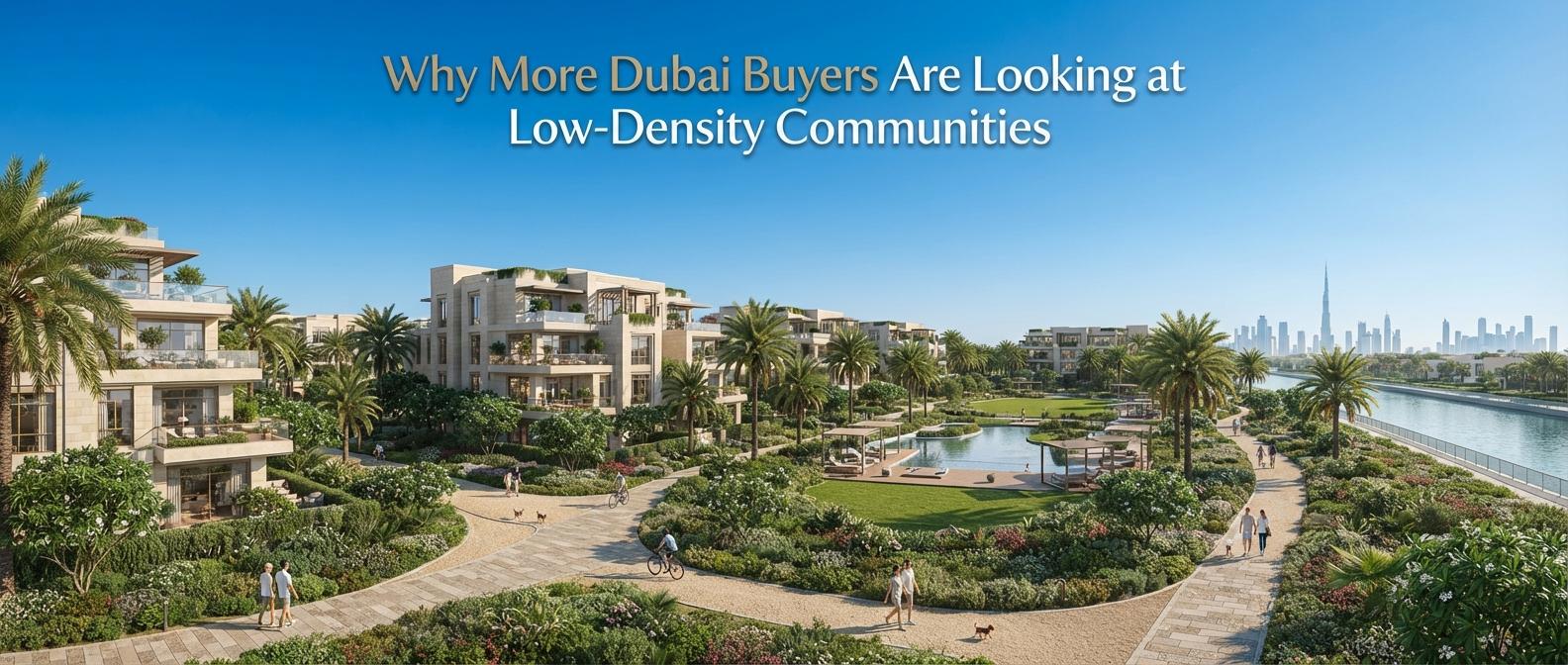
Dubai is often associated with high-rise towers and dense urban districts, but the city's residential market also includes a growing range of low-density communities designed around space, privacy, and family living. For people researching the Dubai property market, this creates an important distinction between choosing a home in a vertical urban environment and choosing a residence within a townhouse or villa community.
The appeal of lower-density living is not necessarily about moving away from the city. Instead, it can offer a different way of experiencing it while remaining connected to major business districts, retail destinations, entertainment venues, and transport routes.
What Is Low-Density Residential Living?
Low-density housing generally refers to communities where residents have more private space and where buildings are less concentrated than in traditional apartment districts.
Townhouses and villas are common examples.
These properties can provide features that are difficult to replicate in many high-rise apartments, including private gardens, larger living areas, terraces, multiple floors, and direct access from the residence to outdoor spaces.
For families in particular, these characteristics can influence the type of home they choose.
At the same time, low-density does not automatically mean suburban or remote. Several townhouse communities are located within Dubai's established urban framework.
Why Families May Prefer Townhouses
Family requirements can change significantly as household size increases.
An apartment that works well for a couple may become less practical when children need additional bedrooms, study areas, storage, and outdoor space.
Townhouses can address some of these requirements through multi-level layouts and larger floor plans.
Private outdoor areas can also provide additional space for children, entertaining, gardening, or simply spending time outside.
This does not mean townhouses are suitable for every buyer. They can involve different maintenance requirements and ownership costs compared with apartments.
The important point is that property type should be considered alongside lifestyle rather than viewed purely as an investment category.
Privacy Is Becoming More Valuable
Privacy is another reason some buyers consider low-density communities.
A townhouse can provide a stronger separation between the home and shared residential spaces.
Residents may have their own entrance, garden, terrace, parking area, or rooftop space depending on the property.
This can create a more private residential experience while still providing access to shared community facilities.
For buyers who spend considerable time at home, these characteristics can have a meaningful impact on everyday living.
Meydan Offers an Alternative to Traditional City Living
Meydan is an interesting example of how Dubai combines central connectivity with residential communities.
The wider area includes a mix of villas, townhouses, apartments, hospitality destinations, and major leisure facilities.
Within this environment, Grand Views townhouses in Meydan provide an example of a lower-density residential format within Millennium Estates.
Current property information describes the community as offering four-bedroom townhouses, with published unit sizes of approximately 3,130 to 3,320 square feet. The development also includes private gardens, rooftop terraces, parking, and premium interior specifications.
The Difference Between Apartment and Townhouse Living
The comparison between an apartment and a townhouse is not simply about size.
An apartment can provide advantages such as shared amenities, lower-maintenance living, building security, and access to central locations.
A townhouse can provide greater privacy, multiple floors, private outdoor space, and a stronger sense of individual ownership.
The choice therefore depends on how the buyer expects to use the property.
Someone who travels frequently may prefer the convenience of an apartment building. A family that spends more time at home may place greater importance on outdoor space and additional rooms.
Community Amenities Still Matter
Living in a low-density development does not mean giving up shared facilities.
Modern townhouse communities can include swimming pools, children's play areas, gyms, landscaped spaces, retail outlets, and community facilities.
These amenities can complement the private features of the individual home.
For families, children's facilities and green areas can be particularly useful. For other residents, fitness facilities and nearby retail may be more relevant.
The combination of private and shared space is one of the defining characteristics of contemporary master-planned communities.
Location Remains Important
A larger home does not necessarily compensate for poor connectivity.
For many Dubai residents, commuting remains an important part of daily life.
This makes access to major roads and employment centres an important consideration when evaluating a townhouse community.
Grand Views is located within Meydan and offers access toward established areas of Dubai, including Downtown Dubai and DIFC. Existing project information also highlights connections to major road networks.
For buyers, the practical question is not simply how far a property is from the city centre but how easily residents can reach the places they regularly need to visit.
Outdoor Space Can Change Daily Life
One of the clearest differences between townhouse and apartment living is access to private outdoor areas.
A garden can provide space for children, pets, outdoor dining, or informal gatherings.
A rooftop terrace can offer another private area for relaxing or entertaining.
However, outdoor space should be evaluated practically.
Buyers can consider its orientation, privacy, maintenance requirements, shade, landscaping, and connection to the main living areas.
A large terrace that is difficult to use during much of the year may have less practical value than a smaller but better-designed outdoor space.
What About Maintenance?
The benefits of additional space also come with responsibilities.
Townhouse owners may need to consider garden maintenance, exterior upkeep, cooling costs, repairs, and other expenses that can differ from those associated with apartment ownership.
Service charges and community fees should also be understood before purchasing.
These costs can vary between communities and property types, so buyers should examine the actual figures for the property rather than relying on general assumptions.
Low-Density Living Does Not Mean Low Connectivity
One misconception about villas and townhouses is that they necessarily require residents to sacrifice access to the city.
Dubai's development pattern has changed considerably.
Several residential communities that offer larger homes are now positioned close to major highways, business districts, shopping destinations, leisure facilities, and established neighbourhoods.
Meydan illustrates this balance.
Residents can have a lower-density home while remaining within the broader central Dubai area.
This combination is one reason communities around MBR City and Meydan continue to form an important part of Dubai's residential landscape.
The Resale Market Provides Another Perspective
For buyers considering a property as a long-term asset, resale activity can provide useful context.
Current market listings show that Grand Views has an active resale market, with recent 2026 transactions recorded for four-bedroom homes and larger properties. For example, fäm Properties reports registered transactions in September 2026, including four-bedroom sales and a larger 5,511-square-foot transaction.
Transaction history should not be interpreted as a guarantee of future performance.
Instead, it can help buyers understand whether properties of a particular type are actually changing hands and at what levels.
This is generally more informative than looking only at advertised asking prices.
Choosing Between Privacy and Convenience
Every property decision involves trade-offs.
A townhouse may offer more space and privacy but require more maintenance.
An apartment may provide easier upkeep and extensive shared facilities but less private outdoor space.
A central location may reduce commuting but come with a higher entry price.
A developing community may provide newer infrastructure but have a less mature surrounding environment.
Understanding these trade-offs can help buyers determine which characteristics matter most to their own circumstances.
What Buyers Should Check Before Choosing a Townhouse
Anyone considering a townhouse can examine several practical factors:
-
Built-up area: How much usable interior space is actually available?
-
Plot size: How much private outdoor space comes with the property?
-
Layout: Does the floor plan work for the household?
-
Privacy: How close are neighbouring homes?
-
Parking: Is there sufficient parking for the household?
-
Community: What facilities and services are available?
-
Connectivity: How convenient are major roads and destinations?
-
Maintenance: What ongoing costs should be expected?
-
Resale: Is there an established market for similar properties?
-
Surrounding development: What changes could affect the community in the future?
These factors create a more complete picture than simply comparing purchase prices.
The Future of Family-Oriented Communities
Dubai's continued population growth and international appeal are creating demand for different forms of housing.
High-rise apartments will remain an important part of the city's residential market, but townhouses and villas provide an alternative for households seeking more space and privacy.
Developers are responding by creating communities that combine private homes with shared amenities, landscaping, retail, and recreational facilities.
This allows residents to enjoy some of the characteristics of suburban living without necessarily moving far away from the city's major destinations.
Final Thoughts
The growing interest in low-density communities reflects a broader change in the way people think about residential property in Dubai.
For some buyers, the ideal home is a high-rise apartment with city views and extensive shared amenities. For others, a townhouse with multiple bedrooms, a private garden, and additional outdoor space may better suit their lifestyle.
Neither format is universally suitable.
The more important question is how the property fits into the buyer's daily routine, financial plans, family requirements, and preferred way of living.
Communities such as Grand Views demonstrate how Dubai's residential landscape can combine larger private homes with the connectivity and infrastructure of a major urban centre.

 English
 French
 Spanish
 Deutsch
 Italiano
 Russian