
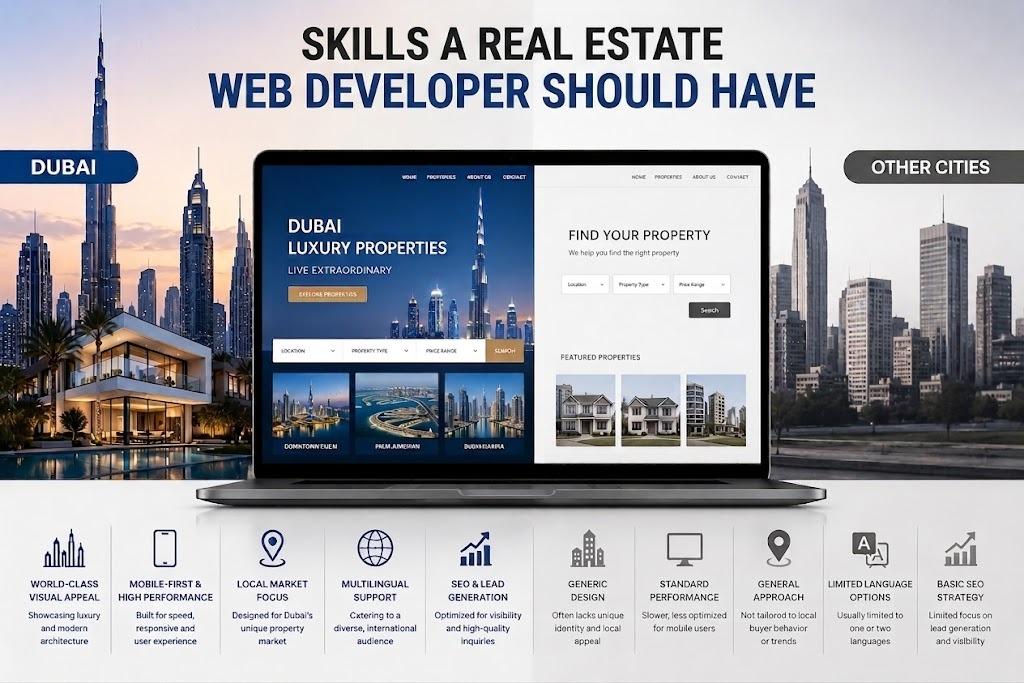
The real estate industry has become deeply digital. Buyers, sellers, and investors now begin their property journey online — searching listings, comparing neighborhoods, and shortlisting agents long before they make a phone call. This shift has made the role of a real estate web developer more important than ever. But not every web developer is equipped to build a platform that meets the unique demands of the property market. Real estate websites require a specific blend of technical, design, and industry-focused skills. In this article, we break down exactly what to look for.
1. Strong Front-End Development Skills
At the core of any great real estate website is clean, responsive front-end development. A skilled real estate web developer should be proficient in:
- HTML5, CSS3, and JavaScript – the foundational building blocks of any website
- Responsive frameworks like Bootstrap or Tailwind CSS to ensure the site works flawlessly across desktops, tablets, and mobile phones
- Modern JavaScript libraries such as React.js or Vue.js, which allow for fast, interactive property search experiences
Since most property buyers browse listings on their phones, mobile responsiveness isn't optional — it's essential. A developer who understands how to build fluid, adaptive layouts will directly impact how long visitors stay on a site and how many convert into leads.
2. Back-End Development Expertise
A real estate website is rarely just a static brochure. It usually needs to handle large property databases, user accounts, saved searches, and dynamic content updates. This requires solid back-end skills, including:
- Server-side languages like PHP, Python, Node.js, or Ruby
- Database management using MySQL, PostgreSQL, or MongoDB
- Building and maintaining RESTful APIs to connect the front end with property data sources
A capable real estate web developer should be able to design a database structure that can scale — handling thousands of property listings without slowing the site down.
3. Experience with MLS and IDX Integration
This is one of the most industry-specific skills a real estate web developer must have. Multiple Listing Service (MLS) and Internet Data Exchange (IDX) integrations allow a website to automatically pull live property listings from real estate databases.
Without this expertise, a developer might build a beautiful website that still requires manual listing updates — which is inefficient and outdated. A developer familiar with IDX/MLS integration can:
- Sync listings in real time
- Ensure data accuracy across multiple sources
- Set up automated feeds so new properties appear instantly
This single skill often separates a general web developer from a true real estate web development specialist.
4. CRM and Lead Management Integration
Generating traffic to a real estate website is only half the job — converting that traffic into leads is the real goal. A skilled developer should know how to integrate:
- Customer Relationship Management (CRM) tools like HubSpot, Salesforce, or industry-specific real estate CRMs
- Lead capture forms with smart validation and instant notifications
- Email marketing automation to nurture leads who aren't ready to buy immediately
This ensures that every inquiry, contact form submission, or saved search is properly tracked and followed up on — turning website visitors into paying clients.
5. SEO Knowledge and Technical Optimization
A beautifully designed real estate website is only valuable if people can find it. That's why a real estate web developer should have working knowledge of on-page and technical SEO, including:
- Clean URL structures for property listings
- Fast page-load speeds through image optimization and caching
- Schema markup for real estate listings, so search engines display rich snippets
- Mobile-first indexing practices
Search engines reward websites that are technically sound, and a developer who understands SEO fundamentals will build a site that's easier to rank — reducing dependency on paid ads over time.
6. UI/UX Design Sensibility
While UX design is often considered a separate discipline, a strong real estate web developer should still understand core design principles. Property websites succeed or fail based on how easily users can:
- Search and filter listings by price, location, size, and amenities
- View high-quality images and virtual tours without lag
- Navigate from a listing page to a contact form in just a few clicks
A developer with UI/UX awareness will build intuitive user flows rather than simply following a design file without questioning usability.
7. Knowledge of Map and Geolocation Tools
Location is everything in real estate. A capable developer should be comfortable integrating:
- Google Maps API or similar geolocation services
- Interactive neighborhood maps with property markers
- Location-based search filters (e.g., "properties near me" or radius search)
These features help users visualize where a property sits in relation to schools, transport, and amenities — a major factor in purchase decisions.
8. Security and Data Protection Skills
Real estate websites often collect sensitive user data — names, phone numbers, financial pre-qualification details, and sometimes payment information for deposits or booking fees. A qualified real estate web developer must understand:
- SSL certificate implementation
- Secure form handling to prevent data leaks
- Protection against common vulnerabilities like SQL injection and cross-site scripting (XSS)
- Compliance with data protection regulations relevant to the region
Security isn't just a technical checkbox — it's a trust factor that affects whether users feel comfortable sharing their information.
9. Content Management System (CMS) Proficiency
Real estate businesses need to update listings, blog content, and promotions regularly — often without relying on a developer for every small change. That's why CMS proficiency matters. A developer should be skilled in platforms like:
- WordPress with real estate-specific themes and plugins
- Webflow for more design-flexible builds
- Custom-built CMS panels for larger real estate portals with unique requirements
This allows real estate teams to manage their own content efficiently after the website goes live.
10. Performance Optimization and Scalability Planning
As a real estate business grows, its website needs to grow with it — more listings, more traffic, more features. A forward-thinking developer plans for scalability by:
- Using efficient database queries
- Implementing caching strategies
- Structuring code in a modular way for easy future updates
This prevents the common problem of websites that perform well initially but slow down or break as the business scales.
Final Thoughts
Building a real estate website isn't the same as building a standard business website. It demands a developer who combines technical depth with an understanding of how property buyers and sellers actually behave online. From MLS/IDX integration and CRM connectivity to SEO, security, and scalable back-end architecture, the right skill set directly impacts lead generation, user trust, and long-term business growth.
When hiring or evaluating a real estate web developer, look beyond general coding ability. Prioritize proven experience with real estate-specific tools and workflows — because in this industry, the right technical foundation can be the difference between a website that generates leads and one that simply looks good.

 English
 French
 Spanish
 Deutsch
 Turkish
 Italiano