
Ground Conditions Are Becoming a Strategic Construction Issue
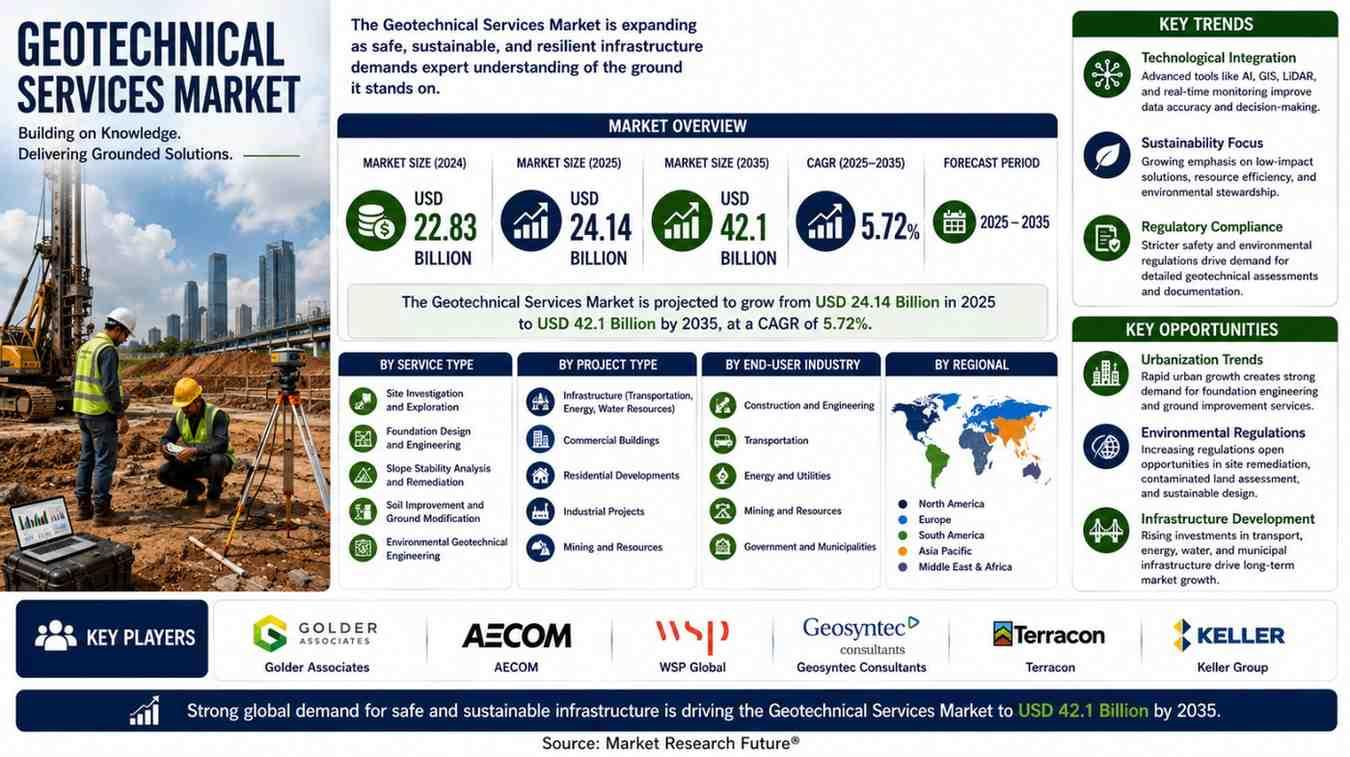
According to Market Research Future®, the Geotechnical Services Market was valued at $22.83 billion in 2024 and is projected to reach $24.14 billion in 2025 and $42.1 billion by 2035, registering a CAGR of 5.72% during 2025–2035. Technological integration, sustainability focus, and regulatory compliance are shaping demand, while urbanization trends, environmental regulations, and infrastructure development are creating opportunities. Key companies include Golder Associates, AECOM, WSP Global, Geosyntec Consultants, Terracon, and Keller Group.
Construction projects often receive the most attention once buildings, roads, bridges, or utilities become visible above ground. Yet many of the risks that determine whether those projects remain safe and economical begin below the surface. Soil variability, groundwater conditions, unstable slopes, weak foundations, and unexpected geological formations can all change project requirements.
This is why geotechnical services are becoming increasingly important to project planning rather than being treated as a preliminary technical exercise.
Site Investigation Is the First Line of Risk Management
Site investigation and exploration provide the information needed to understand subsurface conditions before major construction decisions are finalized.
Investigations can help identify soil characteristics, groundwater conditions, geological structures, and other factors that influence foundation selection and construction methods.
The commercial value is straightforward. Discovering difficult ground conditions before construction is generally easier to manage than discovering them after excavation or foundation work has started.
For project owners, better ground information can therefore support more predictable budgets and schedules.
Urbanization Is Increasing Ground-Engineering Complexity
Urban development is expanding into areas where suitable construction land can be limited.
New projects may need to be built near existing buildings, transportation corridors, utilities, waterways, or previously developed land.
These conditions increase the importance of understanding how excavation, loading, drainage, and foundation work could affect surrounding structures.
Geotechnical specialists can help project teams assess these interactions before construction begins.
Foundation Engineering Has Become More Specialized
A foundation cannot be selected solely according to building size.
Soil strength, settlement characteristics, groundwater, structural loads, and site geometry all influence foundation design.
For large commercial buildings, industrial facilities, infrastructure projects, and high-density developments, foundation engineering can become particularly complex.
Specialized analysis can help engineers select solutions that balance structural requirements, construction feasibility, and cost.
Infrastructure Creates Long-Term Demand
Transportation infrastructure, energy facilities, water resources, and other public projects require substantial ground engineering.
Roads and railways may cross varying soil conditions. Bridges require reliable foundation systems. Water infrastructure can involve challenging ground and groundwater environments.
As governments and private developers invest in infrastructure modernization, geotechnical services become an essential component of project preparation.
Slope Stability Is Becoming More Important
Projects in mountainous or uneven terrain face additional challenges.
Slope instability can threaten roads, buildings, mining operations, and other infrastructure.
Slope stability analysis can identify potential failure mechanisms and help engineers evaluate remediation options.
Climate-related changes in rainfall patterns can also increase attention on drainage and slope behavior, making ground-risk assessment more relevant for long-term infrastructure planning.
Technology Is Changing Field Investigation
Geotechnical engineering increasingly combines traditional fieldwork with digital tools.
Improved surveying, data management, modeling, remote sensing, and analytical software can help engineers interpret subsurface information more efficiently.
The value of technology is not simply faster data collection. Better integration can help project teams connect field observations with design decisions.
That can improve communication between geotechnical engineers, structural engineers, contractors, and project owners.
Soil Improvement Can Unlock Difficult Sites
Not every site requires complete avoidance when ground conditions are poor.
Soil improvement and ground modification techniques can alter ground behavior and make certain locations more suitable for development.
This creates an important economic opportunity because land availability can be a constraint in dense urban areas.
Instead of searching indefinitely for ideal ground, developers can increasingly evaluate whether engineering solutions can make challenging sites viable.
Environmental Requirements Are Expanding the Scope
Environmental geotechnical engineering is becoming more relevant as project teams consider soil contamination, groundwater, remediation, and site reuse.
Brownfield redevelopment is one example where construction decisions depend heavily on understanding both engineering and environmental conditions.
This expands the role of geotechnical consultants beyond traditional foundation analysis.
Regulatory Compliance Supports Demand
Construction projects must meet safety and environmental requirements that vary by jurisdiction and project type.
Regulatory expectations can require detailed investigation, documentation, testing, and engineering review.
Compliance can therefore reinforce demand for specialized geotechnical expertise.
For project owners, the service provides not only technical knowledge but also documentation needed to support approvals and risk management.
Competitive Landscape Is Evolving
Golder Associates, AECOM, WSP Global, Geosyntec Consultants, Terracon, and Keller Group are among the key participants.
Competition increasingly depends on technical specialization, geographic reach, digital capabilities, environmental expertise, and the ability to manage complex projects.
Large firms can provide multidisciplinary services, while specialized consultants can compete through niche expertise.
Challenges Remain
Geotechnical work is inherently site-specific.
Subsurface conditions cannot always be fully characterized from limited investigation points, which means uncertainty remains even after detailed studies.
Field access, testing costs, project timelines, and incomplete historical information can also affect the quality of available data.
The industry therefore needs to balance investigation depth with project budgets and schedules.
The Outlook Through 2035
The projected market value of $42.1 billion by 2035 reflects the growing need to understand and manage ground conditions.
The larger shift is strategic. Geotechnical services are increasingly being viewed as a way to prevent construction problems rather than simply satisfy a design requirement.
As infrastructure becomes denser and development moves into more complicated locations, the ability to understand the ground before building on it will become one of the most important tools for controlling project risk.

 English
 French
 Spanish
 Deutsch
 Turkish
 Russian