
Why the Supply Chain Could Matter More Than Headline Demand
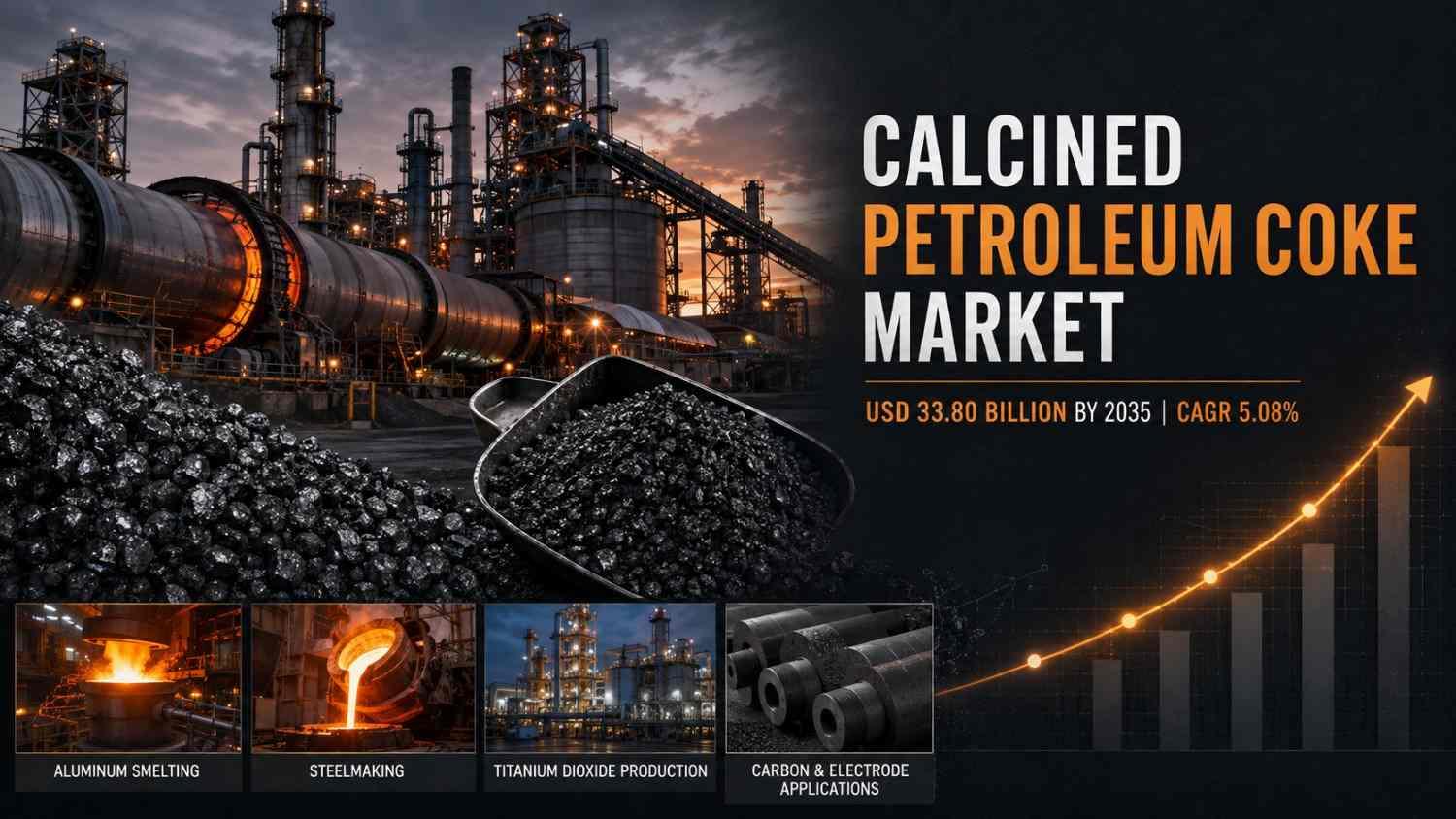
The calcined petroleum coke business is being shaped by an unusual combination of forces: refinery economics on one side and metals, chemicals and environmental policy on the other. The Calcined Petroleum Coke Growth Analysis estimates that the market will increase from USD 20.58 billion in 2025 to USD 33.80 billion by 2035, at a CAGR of 5.08%. The opportunity is supported by aluminum capacity expansion, premium low-sulfur demand and new carbon-material applications, but the economics depend heavily on feedstock availability, processing quality and transportation.
The Hidden Dependency on Refineries
Calcined petroleum coke cannot be separated from the refining industry that produces its feedstock.
Refinery configuration, crude selection and downstream processing determine the characteristics and availability of green petroleum coke. Calcination then adds another layer of cost and technical control.
This creates a dependency that buyers and producers must manage carefully. A strong demand outlook does not automatically guarantee adequate supply of the right quality.
For producers, access to reliable feedstock can be a competitive advantage. For industrial buyers, supplier diversification can reduce exposure to unexpected changes in refinery operations.
Smelters Turn Carbon Into an Industrial Requirement
Aluminum production is one of the strongest structural demand drivers because carbon materials are embedded in the smelting process.
This relationship gives the calcined petroleum coke market a connection to broader trends in transportation electrification, power infrastructure and lightweight materials, although the market's immediate demand mechanism remains aluminum production itself.
The opportunity becomes particularly significant when new smelting capacity is developed. Each project can generate a recurring industrial requirement, provided the supplier can satisfy technical specifications and logistics requirements.
Why Low-Sulfur Material Is Gaining Attention
Environmental compliance is changing how industrial buyers evaluate carbon inputs.
Sulfur is no longer simply a laboratory specification. It can affect downstream emissions management and operating costs. As regulatory expectations tighten, low-sulfur material can become commercially more attractive.
This creates a potential premium segment in which quality control becomes part of the product proposition.
Ultra-low-sulfur grades therefore represent more than a niche technical development. They reflect a broader transition toward materials that help industrial customers manage environmental constraints.
Beyond Aluminum: Multiple Demand Channels
The market's resilience also comes from its application diversity.
Titanium dioxide manufacturing creates one demand channel, while steel-related recarburizing provides another. Other industrial applications contribute to consumption without necessarily following aluminum-sector cycles.
This matters because diversified applications can moderate the effect of a downturn in one industry. At the same time, each customer group may demand different grades, making production planning more complex.
Successful suppliers must therefore balance standardization with the ability to deliver application-specific material.
The New Value Proposition Is Efficiency
Sustainability pressure is forcing the industry to think beyond the traditional question of output.
A more efficient calcination process can reduce energy intensity. Better material control can minimize waste. More precise logistics can reduce unnecessary transportation. Premium grades can improve the value obtained from available feedstock.
These improvements are commercially relevant because environmental performance increasingly overlaps with operating economics.
The industry does not need to claim that petroleum-derived carbon is inherently sustainable. Instead, it can focus on measurable improvements in production, quality and resource utilization.
Battery Materials Could Change the Conversation
Battery-grade carbon materials represent one of the more interesting long-term opportunities.
The appeal is clear: advanced energy-storage technologies require precisely engineered carbon materials, creating potential demand for new feedstock and processing routes.
Yet conventional calcined petroleum coke should not be assumed to be interchangeable with specialized battery materials. Qualification requirements can be demanding, and competing carbon sources may offer different performance characteristics.
The commercial opportunity will emerge only if producers can demonstrate consistent properties at an acceptable cost.
Regional Competition Will Follow Industrial Clusters
Asia-Pacific's importance is closely linked to its manufacturing and metals industries. Large industrial clusters can support both demand and supply-chain efficiency.
North America combines refining capacity with mature industrial customers, creating opportunities for suppliers that emphasize reliability and compliance.
Europe places greater weight on environmental performance, which can increase interest in premium specifications and lower-impact production practices.
The Middle East has strong potential because refinery integration can support feedstock availability and export-oriented production. Africa could become a new demand frontier if aluminum smelting and supporting infrastructure expand.
The Competitive Landscape
The companies identified in the market data—Rain Industries Limited, Oxbow Carbon LLC, BP p.l.c., Phillips 66, Aditya Birla Group and Saudi Calcined Petroleum Coke Co.—illustrate the importance of scale, integration and geographic reach.
Large integrated participants can potentially manage feedstock and processing relationships more efficiently. Specialist suppliers can differentiate through product quality and customer-specific service.
Competitive advantage will increasingly depend on the ability to connect production assets with predictable downstream demand.
Risks Are Not Disappearing
The market faces several structural risks.
A slowdown in aluminum or steel production could weaken demand. Changes in refinery configurations could affect feedstock availability. Environmental rules could increase compliance costs. Energy prices could alter calcination economics. Trade restrictions or logistics disruptions could change delivered-cost competitiveness.
These factors mean that market growth will not be uniform across regions or applications.
The Industry Opportunity Is About Better Matching
The projected 5.08% CAGR indicates a healthy expansion path through 2035. But the most attractive opportunities may come from better matching of feedstock, processing and application.
A supplier that produces exactly what an aluminum smelter, steel manufacturer or advanced-material developer requires can create more value than one that simply increases output.
That is the strategic shift worth watching: calcined petroleum coke is becoming less about a refinery byproduct finding a buyer and more about a specialized industrial material finding the right application.
Another Trending Topics

 French
 Spanish
 Deutsch
 Turkish
 Italiano
 Russian