
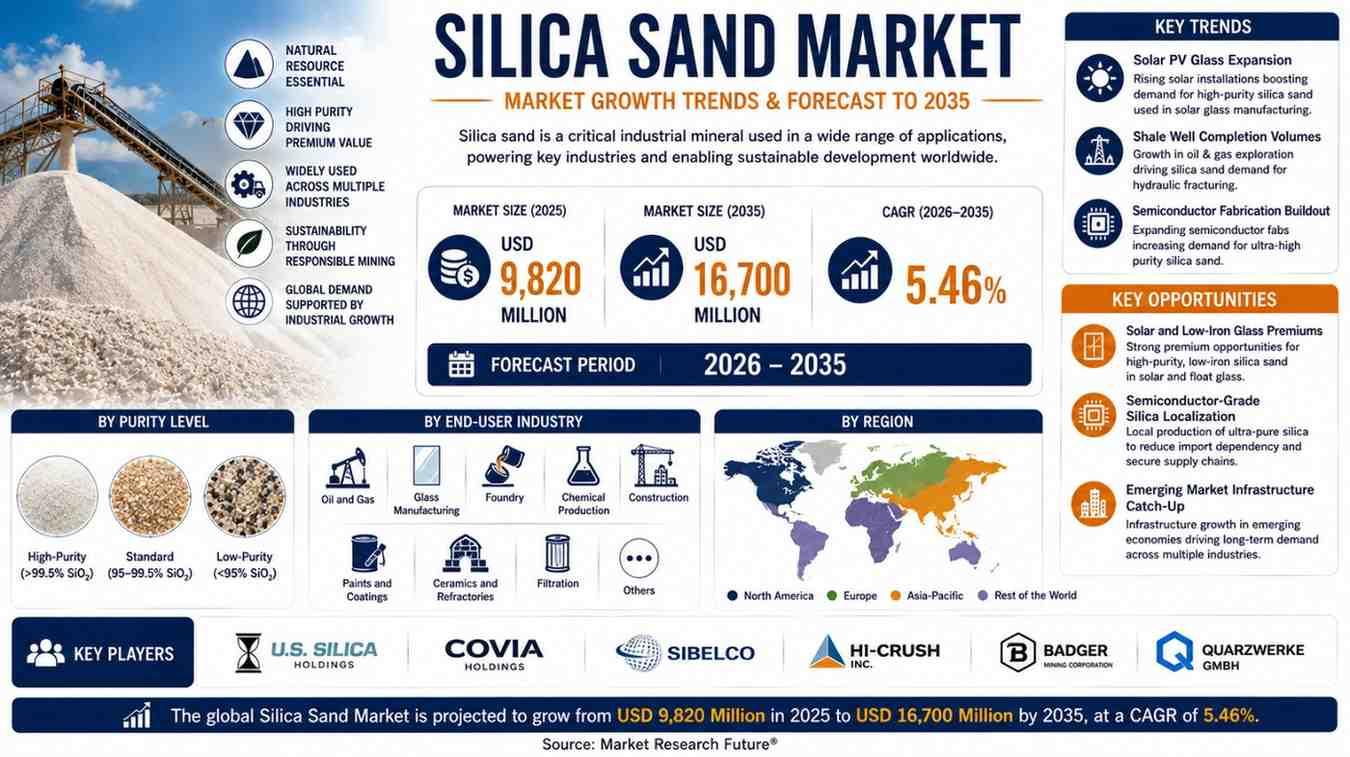
According to Market Research Future®, the Silica Sand Market Industry is projected to expand from USD 9,820 million in 2025 to USD 16,700 million by 2035, registering a CAGR of 5.46% during the 2026–2035 forecast period.
The silica sand market is evolving from a predominantly traditional industrial-minerals business into a more differentiated materials sector, where product purity, particle characteristics, processing technology, and supply reliability increasingly determine commercial value. Silica remains indispensable to glassmaking, foundry operations, construction, oil and gas, filtration, chemical processing, ceramics, and refractories, while new demand from solar glass and semiconductor manufacturing is creating higher-value opportunities.
This shift is particularly visible in the glass industry. Solar photovoltaic deployment is expanding the global requirement for photovoltaic glass, while low-iron glass applications place greater emphasis on carefully controlled silica inputs. Suppliers that can provide consistent chemical composition and appropriate processing characteristics are therefore positioned to participate in premium segments of the market.
Semiconductor manufacturing is another emerging demand center. The expansion of fabrication facilities is increasing attention on high-purity materials and localized supply chains. Although semiconductor-related silica requirements represent a more specialized market than conventional construction applications, the emphasis on purity and quality creates opportunities for producers capable of sophisticated beneficiation and purification.
Oil and gas provides a contrasting but important demand base. Hydraulic fracturing operations consume substantial quantities of silica sand, particularly in shale-producing regions. Well-completion requirements make particle size, strength, roundness, and consistency important considerations for suppliers.
Construction remains a foundational market. Silica sand is used in concrete, mortars, building products, and other applications supporting residential, commercial, and infrastructure development. Foundries similarly rely on silica for molds and cores, while filtration applications use carefully processed sand in water-treatment systems.
The industry's supply side is becoming increasingly technology-driven. Producers are investing in washing, scrubbing, drying, screening, classification, magnetic separation, flotation, beneficiation, and purification technologies. These capabilities enable suppliers to serve a wider range of applications and improve the consistency of finished products.
Environmental considerations are also influencing operating strategies. Water recycling, energy efficiency, land management, material recovery, and improved waste handling are becoming important components of responsible silica production.
Leading companies including U.S. Silica Holdings, Covia Holdings, Sibelco, Hi-Crush Inc., Badger Mining Corporation, and Quarzwerke GmbH continue strengthening their positions through processing investments, specialized product development, logistics capabilities, and supply-chain expansion.
Get a sample report pdf| https://www.marketresearchfuture.com/sample_request/8216
Market Overview
The silica sand industry includes materials differentiated by purity level, physical characteristics, and end-use requirements. High-purity silica contains more than 99.5% SiO₂, standard-grade material contains 95–99.5% SiO₂, and low-purity material contains less than 95% SiO₂.
End-use industries include oil and gas, glass manufacturing, foundries, chemical production, construction, paints and coatings, ceramics and refractories, filtration, and other industrial applications.
This broad segmentation creates different value propositions. Standard grades benefit from large-volume construction and industrial demand, while high-purity products can command greater value where chemical consistency and low impurity levels are essential.
Market Size Analysis
The silica sand market reached USD 9,820 million in 2025, establishing a broad industrial demand base.
Glass manufacturing remains a major consumer. Silica is essential to the production of architectural glass, automotive glass, containers, specialty glass, and photovoltaic glass. The continued expansion of solar PV manufacturing is therefore an important long-term market catalyst.
Oil and gas applications remain significant in hydraulic fracturing markets. Producers serving this segment must meet requirements for particle-size distribution, mechanical strength, and consistency.
Foundry applications rely on silica sand for molding and core production, while construction consumes significant quantities through concrete, mortars, and related building materials. Filtration provides another established application, particularly across municipal and industrial water-treatment systems.
Chemical production, paints and coatings, ceramics, and refractories further diversify the demand base.
2026–2035 Market Forecast
The silica sand market is expected to reach USD 16,700 million by 2035, reflecting a sustained expansion supported by both established and emerging applications.
Solar glass expansion is expected to increase demand for suitable silica resources, particularly where low-iron and specialty glass production requires controlled raw material specifications.
Semiconductor fabrication buildout provides a premium opportunity for high-purity silica suppliers. Regionalization of technology supply chains may further encourage investment in domestic purification and processing capacity.
Emerging-market infrastructure development will continue supporting standard-grade demand across construction, filtration, foundries, and industrial applications.
Technology & Innovation
Processing technology is increasingly central to silica sand competitiveness.
Modern beneficiation systems can improve silica concentration by removing unwanted minerals and controlling physical characteristics. Washing and scrubbing improve cleanliness, while screening and classification provide more precise particle-size control.
Magnetic separation, flotation, and other purification techniques can further improve product quality for specialized applications. Producers serving premium markets are increasingly adopting advanced analytical systems to monitor trace impurities and maintain consistent specifications.
Automation and digitalization are improving processing plants through real-time sensors, automated controls, predictive maintenance, and production analytics. These technologies can improve equipment utilization and reduce operational variability.
Sustainable processing is also becoming strategically important. Water-recycling systems can reduce freshwater requirements, while energy-efficient equipment and waste-recovery systems can lower operating impacts.
Industry Trends
Three trends are particularly influential. First, solar PV glass expansion is strengthening demand for suitable silica raw materials. Second, shale well completion volumes continue affecting frac sand consumption in active oil and gas markets. Third, semiconductor fabrication buildout is increasing interest in high-purity silica and localized supply chains.
Alongside these demand trends, sustainability expectations are encouraging producers to improve resource efficiency, water management, energy consumption, and environmental performance.
Growth Opportunities
Solar and low-iron glass premiums provide opportunities for suppliers capable of delivering consistent, high-quality silica.
Semiconductor-grade silica localization represents a potentially attractive premium market as governments and manufacturers seek greater control over critical-material supply chains.
Emerging-market infrastructure catch-up provides substantial volume opportunities in construction, filtration, foundry, and industrial applications.
Additional growth can come from specialty grades serving ceramics, refractories, chemical processing, paints, and coatings.
Competitive Landscape
The silica sand market remains competitive, with differentiation increasingly based on reserve quality, processing technology, product consistency, logistics, and customer proximity. U.S. Silica Holdings, Covia Holdings, Sibelco, Hi-Crush Inc., Badger Mining Corporation, and Quarzwerke GmbH continue investing in extraction, processing, purification, quality management, and distribution capabilities.
The competitive landscape is likely to favor producers that can combine reliable reserves with advanced processing infrastructure and strong logistics networks.
Professional Conclusion
The silica sand market is positioned for steady expansion through 2035 as traditional industrial demand intersects with new requirements from renewable energy and advanced electronics. A projected increase from USD 9,820 million in 2025 to USD 16,700 million by 2035 reflects the importance of glass manufacturing, oil and gas, construction, foundries, filtration, and emerging high-purity applications.
The industry's future will increasingly depend on the ability to deliver application-specific material quality while managing environmental and supply-chain challenges. Solar PV glass, semiconductor-grade silica, advanced beneficiation, digital processing, water recycling, and localized supply networks are expected to shape the next stage of market development. Producers that successfully combine resource quality, processing expertise, sustainability, and dependable delivery will be best positioned to capture opportunities across both established and emerging silica sand applications.

 English
 French
 Deutsch
 Turkish
 Italiano
 Russian