
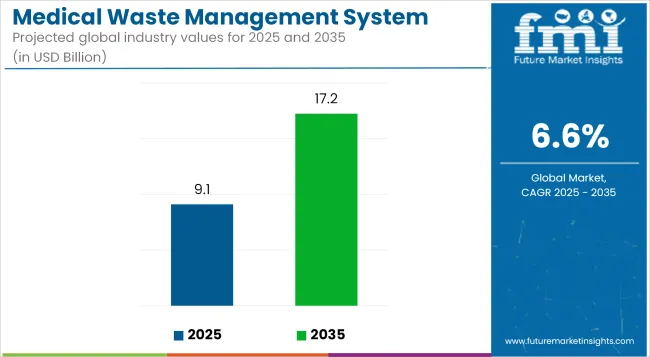
According to Future Market Insights (FMI), the global medical waste management system market is expected to witness sustained growth, driven by increasing healthcare infrastructure expansion, stricter environmental regulations, rising infection control requirements, and growing adoption of digitized waste handling technologies. Healthcare providers worldwide are increasingly integrating advanced waste segregation, tracking, and treatment systems to ensure regulatory compliance, environmental sustainability, and public health safety.
Quick Stats Snapshot – Medical Waste Management System Market
• 2025 Market Size: USD 9.1 billion
• 2035 Forecast: USD 17.24 billion
• CAGR (2025–2035): 6.6%
• Leading System Segment: Waste Segregation Systems (13.6% share)
• Leading Waste Type Segment: Infectious Waste (28.69% share)
• Leading Treatment Site Segment: Offsite Treatment (67.80% share)
• Incremental Opportunity (2025–2035): USD 8.14 billion
• Key Growth Regions: North America and Europe
• Key Players: Stericycle, Clean Harbors, Veolia, Waste Management, Inc., Daniels Health, SUEZ, Remondis, Biomedical Waste Solutions, Republic Services, Sharps Compliance
Request for Sample: https://www.futuremarketinsights.com/reports/sample/rep-gb-5034
Market Size and Outlook
The global medical waste management system market is projected to grow from USD 9.1 billion in 2025 to USD 17.24 billion by 2035, registering a CAGR of 6.6% during the forecast period.
Market growth is being supported by rising healthcare waste volumes, growing awareness regarding infection prevention, and increasingly stringent environmental regulations governing hazardous waste disposal. Hospitals, diagnostic laboratories, research institutions, and healthcare providers are investing in advanced waste management systems to improve operational efficiency and regulatory compliance.
The increasing adoption of digital tracking solutions, automated segregation systems, and environmentally sustainable treatment technologies is further reshaping the industry landscape globally.
Growth Drivers: Regulatory Compliance and Healthcare Infrastructure Expansion
The market is primarily supported by growing demand for safe, traceable, and environmentally responsible waste management solutions.
• Rising Healthcare Waste Generation: Expanding healthcare services and increasing patient volumes creating higher waste disposal requirements
• Stringent Environmental Regulations: Government mandates encouraging adoption of compliant waste handling and treatment systems
• Growing Focus on Infection Prevention: Increased awareness regarding contamination risks driving advanced segregation practices
• Expansion of Healthcare Infrastructure: New hospitals, clinics, and diagnostic facilities increasing demand for waste management systems
• Adoption of Smart Waste Tracking Technologies: RFID, barcode systems, and digital monitoring enhancing traceability and accountability
• Sustainability Initiatives: Growing preference for environmentally friendly treatment and disposal methods
These factors continue to strengthen long-term growth prospects for the medical waste management system market worldwide.
Access Full Report: https://www.futuremarketinsights.com/reports/medical-waste-management-system-market
Key Challenges: Waste Segregation Gaps and Infrastructure Limitations
Despite favorable market conditions, several challenges continue to impact industry growth:
• Inadequate Waste Segregation at Source: Poor categorization increasing treatment complexity and disposal costs
• Limited Infrastructure in Developing Regions: Insufficient treatment facilities affecting safe waste management
• Regulatory Compliance Complexity: Constantly evolving environmental standards requiring ongoing investments
• High Capital Requirements: Advanced treatment systems and monitoring technologies requiring significant upfront expenditure
Organizations investing in workforce training, automation technologies, and integrated waste management infrastructure are expected to strengthen their market position.
Opportunities: Digitalization and Sustainable Waste Treatment Solutions
Several emerging opportunities are reshaping the medical waste management landscape:
• Integration of Digital Monitoring Systems: Real-time waste tracking improving transparency and compliance
• Growth of Smart Waste Segregation Solutions: AI-enabled sorting and automated collection systems enhancing efficiency
• Expansion of Onsite Treatment Technologies: Autoclaves, microwave systems, and chemical disinfection units reducing transportation risks
• Development of Circular Economy Models: Recycling and material recovery initiatives supporting sustainability goals
• Public-Private Partnerships: Government-supported waste treatment infrastructure projects creating new growth opportunities
These developments are expected to improve operational efficiency, reduce environmental impact, and strengthen healthcare waste management capabilities.
Segmentation Insights: Waste Segregation Systems and Infectious Waste Lead Demand
• System Segment: Waste Segregation Systems dominate with a 13.6% share due to growing emphasis on source-level waste categorization and infection control
• Waste Type Segment: Infectious Waste accounts for 28.69% share owing to increasing hospitalization rates and continued concerns regarding communicable diseases
• Treatment Site Segment: Offsite Treatment leads with 67.80% share due to centralized infrastructure advantages, cost optimization, and regulatory compliance capabilities
• Technology Trend: Smart bins, RFID tracking systems, and waste management software platforms gaining significant adoption
• Sustainability Trend: Increasing focus on recycling, material recovery, and low-emission treatment technologies
👉 Explore the Latest Healthcare Industry Analysis Now: https://www.futuremarketinsights.com/industry-analysis/healthcare
Regional Analysis: North America and Europe Maintain Market Leadership
North America and Europe remain the dominant regions due to strong regulatory frameworks and mature healthcare systems, while Asia-Pacific continues to offer attractive growth opportunities.
• United States: Strong market demand supported by stringent EPA and OSHA regulations and increasing healthcare waste generation
• Germany: Growth driven by strict environmental compliance requirements and widespread adoption of digital waste tracking technologies
• India: Expected CAGR of 5.6%, supported by healthcare infrastructure expansion, biomedical waste regulations, and increasing public awareness
• China: Projected CAGR of 6.2%, driven by hospital expansion, centralized waste treatment initiatives, and smart healthcare infrastructure development
• Japan: Growth supported by zero-waste initiatives, aging population trends, and investments in advanced sterilization technologies
• Europe: Increasing focus on circular economy principles and sustainable healthcare operations supporting market expansion
Competitive Landscape: Technology Innovation and Strategic Expansion Drive Competition
The medical waste management system market remains highly competitive, with companies focusing on technological innovation, service expansion, and sustainability initiatives.
Leading organizations focus on:
• Developing AI-powered waste tracking and monitoring systems
• Expanding onsite and mobile waste treatment capabilities
• Enhancing compliance and documentation management solutions
• Investing in environmentally sustainable disposal technologies
• Strengthening partnerships with healthcare providers and government agencies
Recent industry developments include strategic acquisitions, advanced sterilization technologies, digital monitoring platforms, and closed-loop recycling initiatives for healthcare waste materials.
Strategic Implications for Decision-Makers
The medical waste management system market presents substantial opportunities driven by increasing healthcare waste volumes and stricter environmental standards.
• Healthcare providers should prioritize waste segregation and compliance-focused management systems to improve safety and operational efficiency
• Hospitals and clinics can benefit from investments in digital monitoring, automation, and sustainable treatment technologies
• Investors may capitalize on the growing adoption of smart waste management platforms and decentralized treatment solutions
• Service providers focusing on regulatory compliance, digital innovation, and environmental sustainability are expected to strengthen market positioning
As healthcare systems continue to prioritize biosafety, environmental responsibility, and operational transparency, medical waste management systems are expected to play an increasingly critical role in supporting public health and sustainable healthcare delivery worldwide.
Related Reports:
· 3D Printed Medical Devices Market - https://www.futuremarketinsights.com/reports/3d-printed-medical-devices-market
· Manufacturing on Demand for Medical Market - https://www.futuremarketinsights.com/reports/manufacturing-on-demand-for-medical-market
· Medical Equipment Reimbursement Market - https://www.futuremarketinsights.com/reports/medical-equipment-reimbursement-market
· Medical Chairs Market - https://www.futuremarketinsights.com/reports/medical-chairs-market
· Medical Telepresence Robots Market - https://www.futuremarketinsights.com/reports/medical-telepresence-robots-market
About Future Market Insights (FMI)
Future Market Insights (FMI) is a leading provider of market intelligence and consulting services, serving clients across more than 150 countries. Headquartered in Delaware, USA, with a global delivery center in India and offices in the UK and UAE, FMI delivers actionable market insights across healthcare, technology, manufacturing, energy, chemicals, and consumer industries.
For Press & Corporate Inquiries:
Rahul Singh
AVP – Marketing and Growth Strategy
Future Market Insights, Inc.
+91 8600020075
For Sales – sales@futuremarketinsights.com
For Media – Rahul.singh@futuremarketinsights.com
For Web – www.futuremarketinsights.com

 English
 French
 Deutsch
 Turkish
 Italiano
 Russian