
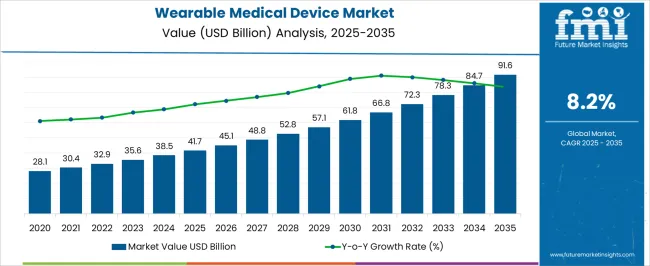
According to Future Market Insights (FMI), the global wearable medical device market is experiencing significant growth, driven by the increasing prevalence of chronic diseases, expanding adoption of remote patient monitoring technologies, advancements in AI-enabled healthcare solutions, and growing preference for home-based care. Wearable medical devices are rapidly evolving from fitness-focused products into clinically validated healthcare tools that support continuous monitoring, personalized treatment, and preventive healthcare management.
Quick Stats Snapshot – Wearable Medical Device Market
• 2025 Market Size: USD 41.7 billion
• 2035 Forecast: USD 91.6 billion
• CAGR (2025–2035): 8.2%
• Leading Product Segment: Wearable Therapeutic Medical Devices (55.0% share)
• Leading Application Segment: Home Healthcare (63.0% share)
• Leading Distribution Channel: Hospital Pharmacies (30.0% share)
• Incremental Opportunity (2025–2035): USD 49.9 billion
• High-Growth Markets: India (18.4% CAGR), Singapore (13.1% CAGR)
• Key Adoption Regions: North America, Asia Pacific, Europe
Request For a Sample: https://www.futuremarketinsights.com/reports/sample/rep-gb-826
Market Size and Outlook
The global wearable medical device market is projected to grow from USD 41.7 billion in 2025 to USD 91.6 billion by 2035, registering a CAGR of 8.2% during the forecast period.
Market expansion is being fueled by the growing burden of chronic diseases, rising healthcare costs, increasing adoption of connected healthcare technologies, and greater demand for continuous health monitoring. Healthcare providers and patients are increasingly embracing wearable devices to improve disease management, enhance patient outcomes, and reduce the frequency of hospital visits.
As healthcare systems worldwide continue shifting toward preventive and value-based care models, wearable medical devices are expected to become a critical component of personalized healthcare delivery.
Growth Drivers: Chronic Disease Management and Connected Healthcare
The market is primarily supported by increasing demand for real-time health monitoring and remote care solutions.
• Rising Prevalence of Chronic Diseases: Growing incidence of diabetes, hypertension, cardiovascular disorders, and respiratory diseases driving demand for continuous monitoring
• Expansion of Remote Patient Monitoring: Healthcare providers increasingly adopting wearable devices to monitor patients outside traditional care settings
• Growing Demand for Preventive Healthcare: Consumers seeking proactive health management and early disease detection solutions
• Integration of AI and Advanced Analytics: Smart wearable devices providing predictive insights and personalized healthcare recommendations
• 5G-Enabled Healthcare Connectivity: High-speed networks supporting real-time data transmission and remote clinical decision-making
• These factors continue to accelerate adoption of wearable medical devices across both consumer and clinical healthcare environments.
Key Challenges: Cybersecurity Risks and Data Privacy Concerns
Despite strong market momentum, several challenges continue to affect industry growth:
• Increasing Cybersecurity Threats: Growing concerns regarding healthcare data breaches and cyberattacks
• Patient Data Privacy Issues: Regulatory requirements surrounding secure storage and transmission of sensitive health information
• High Regulatory Compliance Requirements: Stringent approval processes for clinical-grade wearable devices
• Interoperability Challenges: Integration issues between devices, healthcare platforms, and electronic health records
Companies investing in secure connectivity, data protection technologies, and regulatory compliance frameworks are expected to strengthen their market position.
Access Full Report: https://www.futuremarketinsights.com/reports/wearable-medical-devices-market
Opportunities: AI, Telehealth, and Personalized Healthcare
Several emerging opportunities are reshaping the wearable medical device ecosystem:
• AI-Powered Health Analytics: Advanced algorithms enabling predictive healthcare and early disease intervention
• Telemedicine Integration: Wearable devices supporting virtual consultations and remote clinical monitoring
• Personalized Healthcare Programs: Data-driven treatment plans tailored to individual patient needs
• Expansion in Emerging Markets: Growing healthcare investments creating new opportunities across Asia-Pacific and developing economies
These developments are expected to improve patient engagement, healthcare accessibility, and long-term treatment outcomes.
Segmentation Insights: Therapeutic Devices and Home Healthcare Lead Demand
• Product Segment: Wearable Therapeutic Medical Devices dominate with 55.0% share due to their effectiveness in chronic disease management and therapy delivery
• Application Segment: Home Healthcare accounts for 63.0% share as patients increasingly prefer convenient and cost-effective care at home
• Distribution Channel Segment: Hospital Pharmacies contribute 30.0% of revenue owing to their role in clinically supervised device distribution
• Technology Trend: Integration of AI, machine learning, cloud connectivity, and mobile health applications enhancing device functionality
• Patient Preference: Growing demand for non-invasive, portable, and real-time monitoring solutions supporting personalized care
Regional Analysis: Asia-Pacific Accelerates While North America Maintains Leadership
North America continues to be a major revenue-generating region due to strong digital health infrastructure, high healthcare spending, and rapid adoption of connected medical technologies.
• United States: Rising healthcare expenditure and increasing demand for cost-effective monitoring solutions supporting market growth
• India: Government healthcare initiatives and expanding digital health adoption driving the fastest regional growth rate
• Singapore: Growing investment in smart healthcare technologies accelerating wearable device adoption
• France: Technological advancements and increasing integration of AI-powered medical devices supporting market expansion
• United Kingdom: Strong focus on preventive healthcare and remote patient monitoring creating growth opportunities
• Asia-Pacific: Expanding healthcare access and rising chronic disease burden fueling long-term market development
Competitive Landscape: Innovation and Connectivity Drive Competition
The wearable medical device market remains highly fragmented, with established healthcare technology companies and emerging innovators competing to deliver more advanced, connected, and patient-centric solutions.
Leading companies focus on:
• Developing next-generation wearable therapeutic and monitoring devices
• Integrating AI, machine learning, and predictive analytics capabilities
• Expanding remote patient monitoring and telehealth solutions
• Enhancing sensor accuracy, battery performance, and connectivity features
• Establishing strategic partnerships with healthcare providers and digital health platforms
Competitive advantage increasingly depends on device accuracy, cybersecurity, user experience, interoperability, and clinical validation.
👉 Explore the Latest Healthcare Industry Analysis Now:
https://www.futuremarketinsights.com/industry-analysis/healthcare
Strategic Implications for Decision-Makers
The wearable medical device market presents substantial opportunities as healthcare systems increasingly transition toward connected and home-based care models.
• Healthcare providers should prioritize wearable technologies that improve patient monitoring and clinical outcomes
• Device manufacturers can benefit from investments in AI-enabled diagnostics and secure healthcare connectivity
• Investors may capitalize on growing demand for remote care and digital health solutions
• Companies focusing on chronic disease management, telehealth integration, and personalized healthcare are expected to gain long-term competitive advantages
As healthcare delivery continues to evolve beyond traditional clinical settings, wearable medical devices are expected to play an increasingly important role in preventive care, disease management, and patient empowerment.
FAQs
1. What is the future size of the market?
The wearable medical device market is projected to reach USD 91.6 billion by 2035.
2. What is driving market growth?
Growth is driven by increasing chronic disease prevalence, rising demand for remote patient monitoring, advancements in AI-enabled healthcare technologies, and expanding adoption of home healthcare solutions.
3. Which product segment dominates the market?
Wearable Therapeutic Medical Devices lead the market with a 55.0% share in 2025.
4. Which application segment holds the largest market share?
Home Healthcare dominates with a 63.0% share due to increasing preference for remote care and self-monitoring solutions.
5. Which distribution channel leads the market?
Hospital Pharmacies account for 30.0% of market revenue in 2025.
6. Which regions are driving market growth?
North America remains a leading market, while Asia-Pacific—particularly India and Singapore—is expected to witness the fastest growth through 2035.
7. What opportunities are emerging in the market?
AI-powered analytics, telemedicine integration, personalized healthcare solutions, and expansion into emerging markets are creating significant growth opportunities.
Related Reports:
• Medical Device Technology Market - https://www.futuremarketinsights.com/reports/medical-device-technologies-market
• Homecare Medical Devices Market - https://www.futuremarketinsights.com/reports/homecare-medical-devices-market
• Reprocessed Medical Devices Market - https://www.futuremarketinsights.com/reports/reprocessed-medical-devices-market
• AI-enabled Medical Devices Market - https://www.futuremarketinsights.com/reports/ai-enabled-medical-devices-market
• 3D Printed Medical Devices Market - https://www.futuremarketinsights.com/reports/3d-printed-medical-devices-market
About Future Market Insights (FMI)
Future Market Insights (FMI) is a leading provider of market intelligence and consulting services, serving clients across more than 150 countries. Headquartered in Delaware, USA, with delivery centers in India and offices across the UK and UAE, FMI provides actionable market insights across healthcare, technology, manufacturing, energy, chemicals, and consumer industries.
For Press & Corporate Inquiries:
Rahul Singh
AVP - Marketing and Growth Strategy
Future Market Insights, Inc.
+91 8600020075
For Sales – sales@futuremarketinsights.com
For Media – Rahul.singh@futuremarketinsights.com
For Web – https://www.futuremarketinsights.com/
For Web – https://www.factmr.com/

 French
 Spanish
 Deutsch
 Turkish
 Italiano
 Russian